Criterion 1 – Expected Learning Outcomes
Criterion
Requirements
Quality level assessment

Result
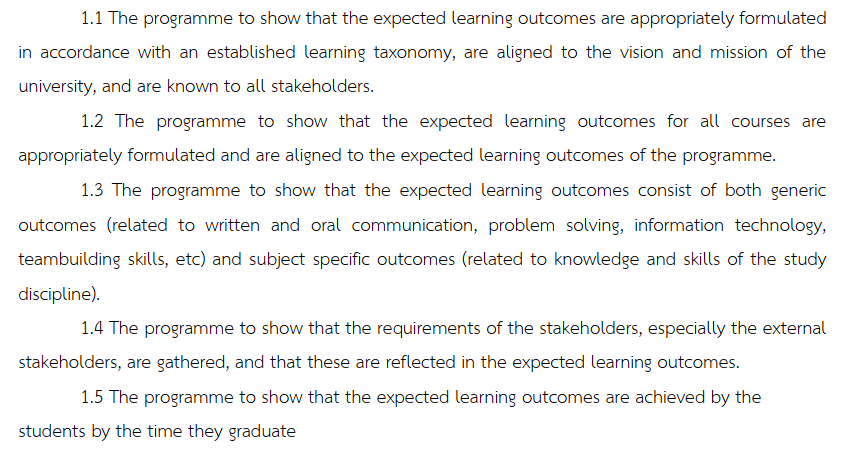
1.1 The programme to show that the expected learning outcomes are appropriately formulated in accordance with an established learning taxonomy, are aligned to the vision and mission of the university, and are known to all stakeholders.
Operational Result
The Master of Education Program in Learning Management Science (M.Ed.-LMS) is offered by the Faculty of Education, St. Theresa International University (TRSU), Nakhon Nayok Province, Thailand. Launched in Academic Year 2020 and comprehensively revised in 2025 in line with the Higher Education Commission (HEC) Standards 2022, the programme prepares graduates to become leaders in learning management science with the capacity to design, implement, evaluate, and improve instructional systems in authentic educational contexts.
The programme is approved by the Teacher Council of Thailand (Khurusapha) and enables graduates to apply for the professional teaching licence. It operates under TRSU’s institutional vision of producing “International graduates with global standards on a foundation of Thai culture” and the Faculty’s mission to develop quality teachers and educational personnel of international standard. The Revised Curriculum 2025 restructured the Programme Learning Outcomes (PLOs) into four dimensions — Knowledge, Skills, Ethics, and Characteristics — aligned with HEC Standards 2022.
The M.Ed.-LMS programme has established a systematic process for formulating, aligning, and disseminating its Programme Learning Outcomes (PLOs). The following describes the key dimensions of this standard:
1. PLO Formulation Using an Established Learning Taxonomy
- The original Curriculum 2020 organised PLOs across six taxonomy-aligned dimensions drawn from Bloom’s Taxonomy: (1) Morals and Ethics, (2) Knowledge, (3) Intellectual Skills, (4) Interpersonal Skills, (5) Communication, Numerical, and Technological Skills, and (6) Learning and Classroom Management Skills. Each PLO was written using measurable action verbs appropriate to master’s-level study, covering cognitive, affective, and psychomotor domains.
- The Revised Curriculum 2025 transformed the PLOs into four dimensions — Knowledge, Skills, Ethics, and Characteristics — in full conformity with HEC Standards 2022. The restructured PLOs retain taxonomy-based measurability while reflecting current national frameworks for higher education quality.
- All PLOs are verified at the graduate (master’s) level through the programme committee’s annual curriculum monitoring and cross-referenced against AUN-QA generic and domain-specific outcome frameworks.
2. Alignment with TRSU Vision and Mission
- TRSU’s vision — producing international graduates with global standards on a foundation of Thai culture — is operationalised in PLOs that emphasise discipline-specific professionalism and international competence, particularly through English-medium instruction.
- The Faculty’s mission to develop quality teachers and educational personnel of international standard is reflected in PLOs targeting instructional design, learning management, educational research, academic leadership, and professional ethics aligned with Teacher Council of Thailand standards.
- The Faculty Strategic Plan 2562–2570 and the Operation Plan 2023–2025 provide the institutional framework within which PLOs are derived, reviewed, and monitored annually.
3. PLO Awareness Among All Stakeholders
- Students: PLOs are formally presented during the annual Orientation Session. Students receive the PLO Summary Sheet, the full curriculum document, and access to the LMS-TRSU platform hosting all programme materials.
- Faculty and Staff: PLOs are reviewed at annual faculty meetings and embedded in every course syllabus. Full-time lecturers holding doctorates with over three years of teaching experience are required to align their courses explicitly to the relevant PLOs.
- External Stakeholders: PLOs and the programme’s approval status are publicly accessible through the Faculty of Education website (https://facultyofeducation.net), the Graduate Programme website, and the Teacher Council of Thailand’s registry. Partner schools across five provinces are informed of the PLOs through placement orientation and annual network meetings.
Evidence
| Evidence ID | Evidence Name | Description / Source |
| 1.1-1 | LMS Curriculum 2025 (Full Document) | Official revised curriculum specifying PLOs in four dimensions (Knowledge, Skills, Ethics, Characteristics) aligned with HEC Standards 2022. Available at https://4fc3e7f5-50a0-4f9f-9bd6-062e287fe7a7.usrfiles.com/ugd/4fc3e7_34b7029bac654c7c9221065a4333306e.pdf |
| 1.1-2 | Programme Learning Outcomes (PLO) Summary Presentation | Gamma.app PLO presentation publicly accessible at https://gamma.app/docs/zmozrc29h4jkhqt, showing all PLOs with taxonomy-aligned verbs for dissemination to all stakeholders. |
| 1.1-3 | LMS Curriculum 2020 (Original) PLO Document | Original six-dimension PLO document documenting Bloom’s Taxonomy-based outcome formulation. Available at https://4fc3e7f5-50a0-4f9f-9bd6-062e287fe7a7.usrfiles.com/ugd/4fc3e7_ddef2aed399442449b5126d122158157.pdf |
| 1.1-4 | Faculty Strategic Plan 2562–2570 | https://facultyofeducation.net/strategic-plan-2560-2563/ |
| 1.1-5 | Faculty Operation Plan 2023–2025 | Annual operation plan showing PLO dissemination activities, orientation schedules, and stakeholder communication. Published at https://facultyofeducation.net/operation-plan/ |
| 1.1-6 | Teacher Council of Thailand Approval Certificate | Official Khurusapha approval confirming the M.Ed.-LMS PLOs meet professional teaching standards. Screenshot at https://drsuphak.files.wordpress.com/2023/07/screenshot-2023-07-11-12.36.59.png |
| 1.1-7 | Orientation Session and Student Sign-In Sheets (Batches 2023–2025) | Records of annual orientations at which PLOs were formally presented and acknowledged by incoming students. |

1.2 The programme to show that the expected learning outcomes for all courses are appropriately formulated and are aligned to the expected learning outcomes of the programme.
Operational Result
The M.Ed.-LMS programme ensures a transparent and verifiable linkage between every Course Learning Outcome (CLO) and the Programme Learning Outcomes (PLOs) through structured curriculum design, an alignment matrix, and an annual review process:
1. PLO–CLO Alignment Matrix
- A Programme–Course Alignment Matrix maps every CLO across all compulsory and elective courses to its contributing PLO(s). The matrix is reviewed by the programme committee at the start of each academic year and revised whenever courses are updated. It is embedded in the Structure of LMS Programme document and the full curriculum files.
- The curriculum structure documents the logical sequence of courses from foundational theory (theories of learning management, research methodology) to advanced application (professional internship, thesis), ensuring progressive and cumulative PLO development across the programme.
2. Syllabus Design and CLO Formulation
- Each course syllabus contains a dedicated CLO section with measurable, taxonomy-aligned verbs at the master’s level. Instructors are required to explicitly map each CLO to its corresponding PLO(s), making alignment transparent to students and assessors.
- The programme employs Work-Integrated Learning (WIL) across multiple courses, anchoring CLOs in authentic professional practice. The Internship and Grading Guideline specifies detailed CLOs for the professional practicum, directly linked to PLOs for learning management competency, professional ethics, and research application.
- The Portfolio Assessment Guideline requires students to produce artefact-based evidence mapped to specific PLO dimensions across all courses, providing a cumulative CLO-attainment record reviewed at the programme level.
3. Annual Curriculum Monitoring and Review
Class timetables for each semester confirm the operational delivery of all PLO-contributing courses throughout the programme.
The Programme Monitoring Calendar schedules annual CLO–PLO alignment verification. Findings are recorded in committee minutes and trigger syllabus revisions where gaps or redundancies are identified.
Evidence
| Evidence ID | Evidence Name | Description / Source |
| 1.2-1 | Structure of LMS Programme Document | Curriculum map showing all compulsory and elective courses, credit hours, sequencing, and PLO contributions. Available at https://4fc3e7f5-50a0-4f9f-9bd6-062e287fe7a7.usrfiles.com/ugd/4fc3e7_123b8a7eac5a4392ba1880cfa6a1bfe5.pdf |
| 1.2-2 | PLO–CLO Alignment Matrix (AY 2025) | Matrix document mapping every course learning outcome to corresponding PLOs across all M.Ed.-LMS courses, reviewed and approved annually by the programme committee. |
| 1.2-3 | Complete Course Syllabi Collection (All M.Ed.-LMS Courses) | Full set of course syllabi with CLOs, PLO mapping, teaching methods, and assessment strategies. Stored in the programme Google Drive repository: https://drive.google.com/drive/folders/1Qgay-CoNce53u5FHt6aRApPR5M1mv9QF |
| 1.2-4 | Internship and Grading Guideline Document | CLOs, grading rubrics, and PLO linkages for the WIL/professional practicum. Referenced at the Guideline for Internship and Grading page on the programme website. https://drsuphak.wixsite.com/graduateschooledstic/about-7-1 |
| 1.2-5 | Portfolio Assessment Guideline | e-Portfolio requirements mapped to PLO dimensions used as a cumulative CLO-attainment tracking tool. Available at https://4fc3e7f5-50a0-4f9f-9bd6-062e287fe7a7.usrfiles.com/ugd/4fc3e7_f2907a0399564853915e30ec7c708e83.pdf Sample students E-portfolio |
| 1.2-6 | Programme Monitoring Calendar | Annual schedule of CLO–PLO alignment verification activities. Published at https://facultyofeducation.net/ |
| 1.2-7 | Class Timetables Semester 1 & 2 / AY 2025 | Operational timetables confirming delivery of all PLO-contributing courses. Available via the M.Ed.-LMS programme page timetable links. 1. Semester 1 2. Semester 2 |
1.3 The programme to show that the expected learning outcomes consist of both generic outcomes (related to written and oral communication, problem solving, information technology, teambuilding skills, etc) and subject specific outcomes (related to knowledge and skills of the study discipline).
Operational Result
The M.Ed.-LMS programme PLOs explicitly encompass both generic (transferable) and subject-specific (discipline-bound) competencies at the graduate level:
A. Generic Outcomes
- Written and Oral Communication: Graduates must demonstrate academic writing proficiency (thesis, research articles, reflective reports) and oral presentation skills (seminar presentations, thesis defence). The programme emphasises English-language communication as a strategic generic competency, reflecting TRSU’s international mission. Addressed through the ‘Skills’ PLO dimension (2025) and the ‘Communication, Numerical, and Technological Skills’ dimension (2020).
- Problem Solving and Critical Thinking: The ‘Intellectual Skills’ dimension (2020) and the ‘Skills’ dimension (2025) require graduates to analyse complex educational challenges, generate evidence-based solutions, and apply innovative thinking to real-world learning management problems.
- Information and Communication Technology (ICT): Both curriculum versions include explicit ICT competency as a PLO. Students are required to use Google Classroom, LMS-TRSU, e-portfolio platforms, and digital research tools throughout the programme.
- Teambuilding and Interpersonal Skills: The ‘Interpersonal Skills’ dimension (2020) and the ‘Characteristics’ dimension (2025) require graduates to collaborate within professional learning communities (PLCs), lead team projects, and manage interpersonal dynamics in educational organisations.
B. Subject-Specific Outcomes
Learning Management Practice and Design: Graduates must design, implement, evaluate, and improve learning management systems in real educational contexts, assessed through WIL practicum evaluations and e-portfolio artefacts.
Advanced Knowledge of Learning Management Science: Graduates must demonstrate deep theoretical and applied knowledge in instructional design, curriculum development, educational psychology, and learning systems management, addressed through core required courses.
Educational Research Competency: All graduates must demonstrate capacity for rigorous, original research. Plan A students produce a full thesis; Plan B students complete an independent study project demonstrating advanced research skill.
Professional Teaching Ethics and Conduct: The ‘Morals and Ethics’ dimension (2020) and the ‘Ethics’ dimension (2025) specify subject-specific professional standards aligned with Teacher Council of Thailand requirements, enabling graduates to obtain the professional teaching licence.
Evidence
| Evidence ID | Evidence Name | Description / Source |
| 1.3-1 | LMS Curriculum 2020 – PLO Document (Six Dimensions) | Six-dimension PLO framework encompassing generic outcomes (Communication, Numerical & Technological Skills; Interpersonal Skills; Intellectual Skills) and subject-specific outcomes (Knowledge; Learning & Classroom Management Skills; Morals & Ethics). Available at https://4fc3e7f5-50a0-4f9f-9bd6-062e287fe7a7.usrfiles.com/ugd/4fc3e7_ddef2aed399442449b5126d122158157.pdf |
| 1.3-2 | LMS Curriculum 2025 – PLO Document (Four Dimensions) | Revised four-dimension PLO framework (Knowledge, Skills, Ethics, Characteristics) per HEC Standards 2022, encompassing both generic and subject-specific outcomes. Full document at https://4fc3e7f5-50a0-4f9f-9bd6-062e287fe7a7.usrfiles.com/ugd/4fc3e7_34b7029bac654c7c9221065a4333306e.pdf |
| 1.3-3 | PLO Generic/Subject-Specific Mapping Table | Programme committee document categorising each PLO as generic or subject-specific, with references to relevant courses and assessment methods, prepared for AUN-QA documentation. |
| 1.3-4 | Portfolio Assessment Guideline – Generic and Discipline Competency Sections | Section of the e-portfolio guideline requiring evidence for both generic competencies (ICT, communication, teamwork) and subject-specific achievements (instructional design, research outputs). At https://4fc3e7f5-50a0-4f9f-9bd6-062e287fe7a7.usrfiles.com/ugd/4fc3e7_f2907a0399564853915e30ec7c708e83.pdf |
| 1.3-5 | Lecturer Qualification Requirements Document | Programme document specifying required competencies for full-time lecturers — academic leadership, instructional design, research skills, English communication, and ICT — reflecting the generic-specific PLO balance expected of graduates. |
1.4 The programme to show that the requirements of the stakeholders, especially the external stakeholders, are gathered, and that these are reflected in the expected learning outcomes.
Operational Result
The M.Ed.-LMS programme maintains a systematic, ongoing process for identifying, collecting, and incorporating stakeholder requirements into its PLOs through multiple engagement channels:
1. External Stakeholder Engagement
- Teacher Council of Thailand (Khurusapha): The programme is formally regulated by the Teacher Council, whose professional competency standards directly inform the professional PLOs. Any revision to Khurusapha’s licensing requirements triggers a corresponding PLO review. Graduate eligibility for the teaching licence is a core external stakeholder requirement built into the PLO architecture.
- Partner Schools and School Administrators: The Faculty maintains a practicum network of schools across five provinces (Nakhon Nayok, Pathum Thani, Prachin Buri, Sa Kaeo, and Nonthaburi/Bangkok). School administrators and supervising teachers provide structured feedback on graduate readiness through end-of-practicum evaluation forms and annual network meetings, directly informing PLO relevance reviews.
- PLC Center for Strengthening (TRSU-PSF — https://www.edtrsupsf.com): The Faculty’s Professional Learning Community Center brings together practising teachers, school leaders, and university staff. Insights on evolving workforce needs — particularly in digital pedagogy and school-based research — are documented and reviewed during curriculum revision cycles, resulting in targeted PLO adjustments.
- STIC-Schools Network and U-Schools Mentoring (https://suphak1954.wixsite.com/mysite): These formal engagement programmes provide structured channels through which schools communicate professional development needs to the Faculty. Documented feedback contributed to the enhanced WIL emphasis and ICT competency focus in the Revised Curriculum 2025.
- ONESQA Network (https://suphak3.wixsite.com/my-site-3): Faculty participation in the national education quality assessment network provides access to national quality standards and employer perspectives reflected in the PLO framework.
2. Internal Stakeholder Consultation
- Students: Exit surveys and cohort-level seminar feedback are conducted each semester. Students reflect on PLO meaningfulness and achievability. Results are reviewed by the programme committee and inform PLO and curriculum adjustments.
- Faculty and Academic Advisors: The advisory team contributes expertise during curriculum monitoring and revision meetings, representing professional practice perspectives from educational organisations and research institutions.
3. Reflection of Stakeholder Requirements in PLOs
- The 2025 PLO restructuring was directly driven by stakeholder consultation. School administrators identified the need for stronger practical ICT and learning management skills, resulting in the enhanced WIL component and the revised ‘Skills’ PLO dimension. The Teacher Council’s updated licensing requirements led to the retention and strengthening of the ‘Ethics’ PLO dimension.
- A Stakeholder Requirement–PLO Reflection Log is maintained by the programme committee documenting each consultation cycle, identified requirements, and the corresponding PLO or curriculum change made in response.
Evidence
| Evidence ID | Evidence Name | Description / Source |
| 1.4-1 | Teacher Council of Thailand Approval and Standards Documentation | Official Khurusapha programme approval certificate and professional standards framework informing PLO formulation. Screenshot at https://drsuphak.files.wordpress.com/2023/07/screenshot-2023-07-11-12.36.59.png |
| 1.4-2 | Partner School Network List (Five Provinces) | Official list of practicum partner schools across Nakhon Nayok, Pathum Thani, Prachin Buri, Sa Kaeo, and Nonthaburi/Bangkok, whose supervisors provide PLO-relevant graduate readiness feedback. Published at https://facultyofeducation.net/ |
| 1.4-3 | Practicum Supervisor Evaluation Forms and Annual Feedback Reports | Completed evaluation forms from school supervisors assessing intern competency against PLO-aligned rubrics, plus annual feedback synthesis reports used in PLO review. 1. Assessment form 1 2. Assessment form 2 |
| 1.4-4 | PLC Center Activity Reports (TRSU-PSF) | Records of PLC sessions at https://www.edtrsupsf.com documenting stakeholder-identified learning management science needs incorporated into PLO revisions. => Centre for Strengthening Teaching Profession [CSTP] |
1.5 The programme to show that the expected learning outcomes are achieved by the students by the time they graduate
Operational Result
The M.Ed.-LMS programme employs a multi-layered assessment system to systematically verify and document PLO attainment by every student prior to graduation:
1. Course-Level Assessment
- Each course employs CLO-mapped instruments — examinations, coursework, research presentations, instructional design projects, and practical demonstrations — providing direct evidence of CLO attainment. Aggregated results are reviewed by the programme committee as programme-level PLO evidence.
- Semester Seminars at the end of each semester allow students to present integrated work to a faculty panel, providing formative evidence of oral communication, critical thinking, and subject knowledge PLOs. Records are maintained in the cohort Monitoring Room on Google Classroom.
2. e-Portfolio Assessment
- The e-Portfolio Assessment is the primary summative PLO verification tool. Each student maintains a longitudinal e-portfolio documenting artefacts and reflections mapped to all PLO dimensions throughout the programme. The Portfolio Assessment Guideline specifies required contents and rubrics for each PLO dimension.
- e-Portfolios are evaluated by a faculty panel at programme completion against the PLO rubric, providing holistic evidence of graduate readiness. Example portfolios are publicly accessible from the programme website (https://drsuphak.wixsite.com/graduateschooledstic/about-7).
3. Thesis and Independent Study
- Plan A (Thesis): Students successfully defend an original research thesis before an examination committee. Examiner rubrics directly assess PLOs in knowledge generation, research competency, critical thinking, oral communication, and professional ethics.
- Plan B (Independent Study + Coursework): Students produce a substantial independent study project assessed against relevant PLOs for advanced knowledge application and research skill.
4. Professional Practicum Assessment
- The WIL component requires students to complete supervised placements at partner schools. School supervisors assess interns against PLO-aligned rubrics covering professional teaching competence, learning management skill, ethics, and interpersonal effectiveness. Results are recorded in the cohort Monitoring Room and reviewed by the programme director.
5. Post-Graduation Follow-Up
The Improvement Plan 2566–2568 documents how PLO attainment data drives specific enhancement actions in teaching, assessment, and curriculum design, demonstrating a closed-loop quality assurance cycle.
The annual Graduate Follow-Up Survey assesses the degree to which graduates are successfully applying their learning in professional practice and collects employer feedback on graduate PLO competency. Results are reported to the Faculty IQA system.
The Faculty IQA Database records programme-level quality indicators including assessment results, graduation rates, employment outcomes, and stakeholder satisfaction, providing cumulative evidence of PLO achievement across cohorts.
Evidence
| Evidence ID | Evidence Name | Description / Source |
| 1.5-1 | e-Portfolio Assessment Guideline and Example Portfolios | PLO-mapped portfolio requirements and representative student portfolios demonstrating PLO attainment across all four dimensions. Guideline: https://4fc3e7f5-50a0-4f9f-9bd6-062e287fe7a7.usrfiles.com/ugd/4fc3e7_f2907a0399564853915e30ec7c708e83.pdf | Examples: https://drsuphak.wixsite.com/graduateschooledstic/about-7 |
| 1.5-2 | Thesis Defence Records and Examination Committee Reports | Archived records of Plan A thesis defences, including examiner evaluation sheets, grades, and committee recommendations evidencing PLO attainment in research and advanced knowledge competencies. |
| 1.5-3 | Practicum Assessment Records – All Cohorts (Batch 2021–2025) | Completed practicum evaluation forms from partner school supervisors, scored against PLO-aligned rubrics, for all students who completed the WIL/internship component. |
| 1.5-4 | Semester Seminar Evaluation Records (All Batches) | Evaluation sheets, panel comments, and attendance records from end-of-semester seminars documenting progressive PLO attainment. Google Classroom Monitoring Room records per cohort. |
| 1.5-5 | Graduate Follow-Up Survey Reports (Annual) | Annual post-graduation survey reports and employer satisfaction data providing evidence that M.Ed.-LMS PLOs translate to professional competency. Lodged with the Faculty IQA committee. |
| 1.5-6 | IQA Database Records (AY 2560–2565) | Faculty IQA database showing programme PLO attainment data, graduation statistics, assessment results, and stakeholder satisfaction ratings. https://facultyofeducation.net/ (IQA Database section). |
| 1.5-7 | Programme Improvement Plan 2566–2568 | Improvement plan demonstrating how PLO attainment data drives targeted programme enhancement, closing the quality assurance loop. https://facultyofeducation.net/improvement-plan-2021/ |
Self-Assessment
| Requirements | Result | Score |
| 1.1 The programme to show that the expected learning outcomes are appropriately formulated in accordance with an established learning taxonomy, are aligned to the vision and mission of the university, and are known to all stakeholders. | / | 1 |
| 1.2 The programme to show that the expected learning outcomes for all courses are appropriately formulated and are aligned to the expected learning outcomes of the programme. | / | 1 |
| 1.3 The programme to show that the expected learning outcomes consist of both generic outcomes and subject specific outcomes. | / | 1 |
| 1.4 The programme to show that the requirements of the stakeholders, especially the external stakeholders, are gathered, and that these are reflected in the expected learning outcomes. | / | 1 |
| 1.5 The programme to show that the expected learning outcomes are achieved by the students by the time they graduate | / | 1 |
| Overall | 5 | |