Criterion 2 – Programme Structure and Content
Criterion
Requirements
Quality level assessment

Result
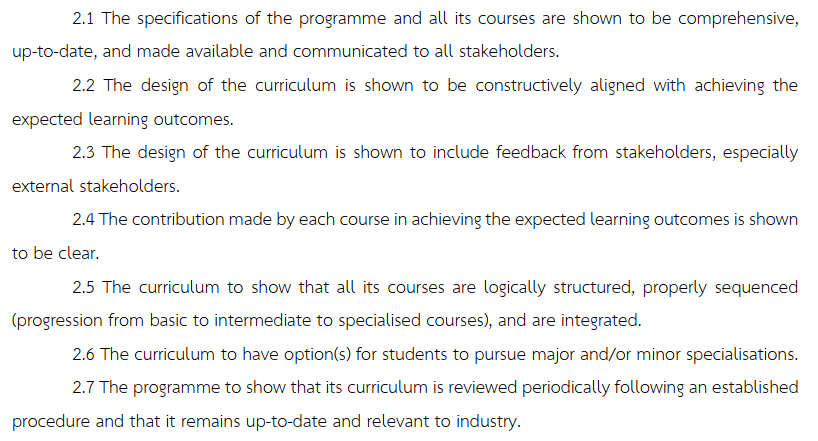
2.1 The specifications of the programme and all its courses are shown to be comprehensive, up-to-date, and made available and communicated to all stakeholders.
Operational Result
The M.Ed.-LMS programme maintains a comprehensive and publicly accessible set of programme and course specifications that are kept current through a structured annual review process. The Revised Curriculum 2025 was developed throughout 2024 and officially adopted from Academic Year 2025, replacing the Curriculum 2020. All updated specifications are disseminated through multiple channels to ensure that all internal and external stakeholders have timely and accurate access.
Key points:
- The LMS Curriculum 2025 document contains the full programme specification, including programme philosophy, PLOs, course descriptions, credit requirements, study plans, and qualification requirements for both instructors and supporting staff. It is publicly downloadable from the programme website.
- The Structure of LMS Programme document provides a concise overview of all compulsory and elective courses, credit distribution, and study plan options (Plan A: Thesis and Plan B: Independent Study), enabling students and external parties to understand the programme at a glance.
- The Programme Learning Outcomes (PLO) Summary, presented via a Gamma.app interactive presentation, is openly accessible online and designed for quick stakeholder communication.
- Course specifications are embedded in individual course syllabi, which are stored in the programme’s Google Drive shared repository and made available to students at the start of each semester.
- Operational plans for each semester (Operation Plan 1/2025 and 2/2025), academic calendars, and class timetables are published on the programme website, allowing students, faculty, and partner institutions to plan accordingly.
- The programme page (https://drsuphak.wixsite.com/graduateschooledstic/copy-of-grad-dip-english) serves as the central public hub for all programme information, updated each academic year.
- The Faculty of Education website (https://facultyofeducation.net) provides institutional-level navigation to all programme documents through the Curriculum and Management System menus.
- An introductory video of the graduate programme (https://youtu.be/6NtBmQmFoHA) is publicly accessible for prospective students and external stakeholders.
Evidence
2.2 The design of the curriculum is shown to be constructively aligned with achieving the expected learning outcomes.
Operational Result
Constructive alignment is a fundamental design principle of the M.Ed.-LMS curriculum. Every element of the curriculum — from course content and teaching methods to assessments and the overall programme structure — is intentionally designed to contribute to and measure the attainment of the Programme Learning Outcomes (PLOs).
Key points:
- The curriculum’s PLO framework was formulated using established learning taxonomy principles. The Curriculum 2020 organised PLOs across six taxonomy-aligned dimensions (Morals & Ethics, Knowledge, Intellectual Skills, Interpersonal Skills, Communication & Technological Skills, Learning and Classroom Management Skills). The Revised Curriculum 2025 restructured these into four dimensions — Knowledge, Skills, Ethics, and Characteristics — in accordance with HEC Standards 2022, retaining full taxonomy alignment.
- A PLO–CLO Alignment Matrix maps every Course Learning Outcome (CLO) across all compulsory and elective courses to its corresponding PLO(s), making the constructive alignment architecture transparent and auditable.
- Teaching and learning methods are selected to match the cognitive level of each PLO. The programme employs a hybrid delivery model combining on-site and online instruction, with a strong emphasis on Work-Integrated Learning (WIL), where students apply learning in real school contexts. This ensures that instructional methods are congruent with the applied, professional nature of the PLOs.
- Assessment methods are explicitly aligned to PLOs. The programme uses a multi-instrument approach: examinations for knowledge PLOs, semester seminar presentations for communication and intellectual skill PLOs, practicum assessments for professional teaching competency PLOs, and e-portfolio assessment for holistic PLO attainment verification.
- The Portfolio Assessment system requires students to compile evidence of PLO attainment across all dimensions throughout their programme of study, providing direct documentation of constructive alignment in action.
- The Foundation Strengthening and Character Strengthening supplementary activity documents provide co-curricular alignment, linking character development activities to the Ethics and Characteristics PLO dimensions.
- The approved Curriculum 2025 presentation to the university council (University Senate, 27 February 2025) confirms institutional endorsement of the constructively aligned curriculum design.
Evidence
| ID | Evidence Name | Source |
|---|---|---|
| 2.2-1 | LMS Curriculum 2025 – PLO Framework (Four Dimensions) | https://4fc3e7f5-50a0-4f9f-9bd6-062e287fe7a7.usrfiles.com/ugd/4fc3e7_34b7029bac654c7c9221065a4333306e.pdf |
| 2.2-2 | PLO–CLO Alignment Matrix (Programme Committee Document, AY 2025) | Programme Google Drive Repository |
| 2.2-3 | Portfolio Assessment Guideline | https://4fc3e7f5-50a0-4f9f-9bd6-062e287fe7a7.usrfiles.com/ugd/4fc3e7_f2907a0399564853915e30ec7c708e83.pdf |
| 2.2-4 | Foundation Strengthening Document | https://4fc3e7f5-50a0-4f9f-9bd6-062e287fe7a7.usrfiles.com/ugd/4fc3e7_2c7f70f697d04f9fa420a5b13d93b5e3.pdf |
| 2.2-5 | Character Strengthening Document | https://4fc3e7f5-50a0-4f9f-9bd6-062e287fe7a7.usrfiles.com/ugd/4fc3e7_1244f165cf0044e5a67ad5fc24ba95a1.pdf |
| 2.2-6 | Approved Curriculum 2025 – University Senate Presentation (27 Feb 2025) | https://gamma.app/docs/MEdin-Learning-Management-Science–1x05vf2io8cdvus |
| 2.2-7 | Internship and Grading Guideline (WIL Assessment Document) | https://drsuphak.wixsite.com/graduateschooledstic/about-7-1 |
2.3 The design of the curriculum is shown to include feedback from stakeholders, especially external stakeholders.
Operational Result
The M.Ed.-LMS curriculum was designed and subsequently revised through a systematic process of stakeholder consultation, with particular emphasis on external stakeholder input. Evidence of this process is documented across multiple cycles of engagement:
Key points:
- Teacher Council of Thailand (Khurusapha): The programme is formally approved by the Teacher Council, whose professional competency standards for licensed teachers are a primary input to curriculum design. Both the Curriculum 2020 and the Revised Curriculum 2025 were structured to ensure graduates meet Khurusapha licensing requirements, reflected in the PLO dimensions of professional ethics, knowledge, and teaching competency.
- Partner Schools Network (Five Provinces): The Faculty maintains formal relationships with partner schools across Nakhon Nayok, Pathum Thani, Prachin Buri, Sa Kaeo, and Nonthaburi/Bangkok. School administrators and supervising teachers who participate in the WIL internship programme provide structured feedback on graduate readiness, which is reviewed during curriculum monitoring and used to inform curriculum adjustments. Their input drove the enhanced emphasis on practical learning management skills in the Revised Curriculum 2025.
- PLC Center for Strengthening (TRSU-PSF): The Faculty’s Professional Learning Community Center (https://www.edtrsupsf.com) connects the programme with practising teachers and school leaders who identify current skill gaps in the profession. These insights are incorporated into curriculum design decisions.
- STIC-Schools Network and U-Schools Mentoring: These two formal outreach programmes (https://suphak1954.wixsite.com/mysite and https://suphak1954.wixsite.com/schdevstic) provide structured channels for schools to communicate workforce development priorities that are reviewed alongside curriculum development activities.
- ONESQA Network: Participation in the national education quality assessment network (https://suphak3.wixsite.com/my-site-3) exposes the programme to national quality benchmarks and employer perspectives, both of which inform curriculum relevance.
- Internal Stakeholders: Student exit surveys and seminar feedback sessions provide cohort-level input that complements external stakeholder data. Academic advisors contribute professional experience from the field during curriculum committee meetings.
- The Setting Curriculum Objectives and PLOs document records the rationale and stakeholder input process that shaped the original curriculum design, providing an audit trail of stakeholder-driven decisions.
- The Curriculum Revision Committee Meeting Minutes (2024–2025) document how stakeholder feedback was deliberated and translated into specific curriculum changes, including the restructuring of PLOs and the strengthening of the WIL component.
Evidence
| ID | Evidence Name | Source |
|---|---|---|
| 2.3-1 | Teacher Council of Thailand Programme Approval Certificate | https://drsuphak.files.wordpress.com/2023/07/screenshot-2023-07-11-12.36.59.png |
| 2.3-2 | Stakeholders’ Feedback | https://facultyofeducation.net/ |
| 2.3-3 | Setting Curriculum Objectives and PLOs Document | https://drsuphak.wixsite.com/website/general-4 |
| 2.3-4 | PLC Center for Strengthening (TRSU-PSF) Activity Records | https://www.edtrsupsf.com |
| 2.3-5 | STIC-Schools Network Documentation | https://suphak1954.wixsite.com/mysite |
| 2.3-6 | U-Schools Mentoring Documentation | https://suphak1954.wixsite.com/schdevstic |

2.4 The contribution made by each course in achieving the expected learning outcomes is shown to be clear.
Operational Result
The M.Ed.-LMS programme makes the contribution of each course to the PLOs explicit through a combination of curriculum mapping, syllabus design, and a programme-level alignment matrix. This ensures that no PLO is left unaddressed and that the cumulative effect of all courses produces well-rounded graduates.
Key points:
- Each course syllabus contains a dedicated section specifying the Course Learning Outcomes (CLOs), the PLO(s) to which each CLO contributes, the assessment instruments used to measure each CLO, and the teaching and learning activities employed. This makes the PLO contribution of every course immediately transparent to students, faculty, and assessors.
- The PLO–CLO Alignment Matrix presents a programme-wide view of how all courses collectively cover all PLO dimensions (Knowledge, Skills, Ethics, and Characteristics). The matrix is reviewed annually by the programme committee to identify gaps, redundancies, or misalignments.
- The Structure of LMS Programme document categorises all courses by type (required/elective), semester, credit load, and PLO contribution, enabling a holistic view of the curriculum’s coverage.
- Required courses cover foundational and advanced knowledge PLOs, research competency PLOs, and professional ethics PLOs, ensuring that all graduates without exception attain the core disciplinary outcomes.
- Elective courses allow students to extend their attainment in specialised skill PLOs aligned with their professional interests (e.g., technology integration in learning management, advanced instructional design).
- The thesis or independent study (Plan A and Plan B respectively) functions as the capstone contribution to the research competency and knowledge generation PLOs, requiring students to independently produce original academic work.
- The WIL internship component is the primary course contribution to the professional practice PLOs (teaching competency, learning management, professional ethics in the classroom), formally assessed by both school supervisors and the programme director.
- The Programme Quality Management System document (published on the programme website) describes the integrated role of each system component — courses, WIL, portfolio, thesis — in achieving the full set of PLOs.
Evidence
| ID | Evidence Name | Source |
|---|---|---|
| 2.4-1 | Course Contribution to Programme Learning Outcomes | Course Contribution to Programme Learning Outcomes |
| 2.4-2 | Complete Course Syllabi Collection | https://drive.google.com/drive/folders/1Qgay-CoNce53u5FHt6aRApPR5M1mv9QF |
| 2.4-3 | Structure of LMS Programme Document | https://4fc3e7f5-50a0-4f9f-9bd6-062e287fe7a7.usrfiles.com/ugd/4fc3e7_123b8a7eac5a4392ba1880cfa6a1bfe5.pdf |
| 2.4-4 | Internship and Grading Guideline (WIL PLO Contribution) | https://drsuphak.wixsite.com/graduateschooledstic/about-7-1 |
| 2.4-5 | Portfolio Assessment Guideline (Capstone PLO Mapping) | https://4fc3e7f5-50a0-4f9f-9bd6-062e287fe7a7.usrfiles.com/ugd/4fc3e7_f2907a0399564853915e30ec7c708e83.pdf |
| 2.4-6 | Programme Quality Management System Description | https://drsuphak.wixsite.com/graduateschooledstic/copy-of-grad-dip-english |
2.5 The curriculum to show that all its courses are logically structured, properly sequenced (progression from basic to intermediate to specialised courses), and are integrated.
Operational Result
The M.Ed.-LMS curriculum is designed with a clear and deliberate progression structure that takes students from foundational knowledge to advanced specialised competency, while integrating theory, practice, and research throughout.
Key points:
- Foundational Stage (Early Semesters): Students begin with courses that establish theoretical and conceptual foundations in learning management science, educational psychology, research methodology, and professional ethics. These courses ensure all students, regardless of prior background, develop the baseline knowledge and academic skills required for advanced study.
- Intermediate Stage (Mid-Programme): Courses in this stage build on the foundation by introducing applied instructional design, curriculum development, learning management systems technology, and advanced educational research methods. Students begin integrating theory with practice through WIL activities and seminar projects.
- Specialised and Capstone Stage (Final Semesters): Students complete advanced electives in their area of specialisation, undertake the full WIL professional internship, and conduct their thesis (Plan A) or independent study (Plan B). These activities synthesise all prior learning and demonstrate mastery of the PLOs at the graduate level.
- Prerequisite Structure: The curriculum specifies prerequisite requirements for advanced courses, ensuring students are adequately prepared before progressing to higher-level content. This is documented in the Structure of LMS Programme and individual course syllabi.
- Integration of Research and Practice: The programme integrates research skill development progressively across semesters, beginning with research methodology courses, progressing through thesis proposal seminars and supervision, and culminating in the thesis defence or independent study presentation. This vertical integration ensures research competency is built cumulatively rather than treated as an isolated requirement.
- Integration of Academic Services and WIL: The programme explicitly integrates academic service activities, PLC participation, and WIL placements with formal coursework, so that students’ professional practice experience continuously informs and enriches their classroom learning. This horizontal integration is a defining feature of the programme’s Work-Integrated Learning approach.
- The Programme Monitoring Calendar tracks the delivery sequence across all semesters and confirms that courses are offered in their designated sequence each academic year.
- Semester Seminar System: End-of-semester seminars serve as integration checkpoints, requiring students to present cohesive summaries of their semester’s learning progress, demonstrating how individual courses contribute to an integrated understanding of learning management science.
Evidence
| ID | Evidence Name | Source |
|---|---|---|
| 2.5-1 | Structure of LMS Programme (Sequencing and Prerequisites) | https://4fc3e7f5-50a0-4f9f-9bd6-062e287fe7a7.usrfiles.com/ugd/4fc3e7_123b8a7eac5a4392ba1880cfa6a1bfe5.pdf |
| 2.5-2 | LMS Curriculum 2025 (Programme Design and Rationale) | https://4fc3e7f5-50a0-4f9f-9bd6-062e287fe7a7.usrfiles.com/ugd/4fc3e7_34b7029bac654c7c9221065a4333306e.pdf |
| 2.5-3 | Research Monitor | https://facultyofeducation.net/e0b89be0b8a3e0b8b4b0b8ab0b8b2b0b8a3b0b8ab0b8a5b0b8b1b0b881b0b8aab0b8b9b0b895b0b8a3-2560/ |
| 2.5-4 | Semester Seminar Schedule and Evaluation Records (All Batches) | Google Classroom Monitoring Rooms |
| 2.5-5 | Thesis Conducting Schedule | https://drsuphak.wixsite.com/graduateschooledstic/copy-of-grad-dip-english |
| 2.5-6 | Schedule of Conducting Thesis (AY 2024) | https://4fc3e7f5-50a0-4f9f-9bd6-062e287fe7a7.usrfiles.com/ugd/4fc3e7_9ff8b35057224c7eb55e7 |
2.6 The curriculum to have option(s) for students to pursue major and/or minor specialisations.
Operational Result
The M.Ed.-LMS programme provides structured options that allow students to tailor their academic focus according to their professional goals and licensing requirements, while ensuring all graduates achieve the full set of programme PLOs.
Key points:
- The programme offers two study plans, providing distinct academic pathways:
- Plan A (Thesis Plan): Students complete a reduced number of taught courses and produce a full master’s thesis through original research. This plan is suited to students who intend to pursue academic careers, doctoral studies, or positions requiring advanced research competency in learning management science.
- Plan B (Independent Study + Coursework Plan): Students complete a larger number of taught courses and produce an independent study project. This plan is suited to practising educators who wish to deepen their professional knowledge and skills across a broader range of learning management topics.
- Within the programme structure, students may select from elective courses that allow them to concentrate on particular areas within learning management science, such as digital learning and educational technology, curriculum development, instructional leadership, or school-based research.
- Teaching Licence Pathway: The programme offers a specific pathway (Plan 2.1(2)) approved by the Teacher Council of Thailand for students who seek the professional teaching licence (Khurusapha licence) alongside the master’s degree. This pathway includes additional professional standards requirements. Students who do not require the teaching licence may follow Plan 2.1(1).
- The Guideline for Internship and Grading document specifies the WIL requirements for each plan, ensuring that professional practicum is appropriately tailored to each pathway.
- The LMS 2025 and the Future planning document outlines potential future specialisation directions for the programme, reflecting the Faculty’s commitment to expanding pathway options in response to evolving educational workforce needs.
Evidence
| ID | Evidence Name | Source |
|---|---|---|
| 2.6-1 | LMS Curriculum 2025 – Study Plan Options (Plan A and Plan B) | https://4fc3e7f5-50a0-4f9f-9bd6-062e287fe7a7.usrfiles.com/ugd/4fc3e7_34b7029bac654c7c9221065a4333306e.pdf |
| 2.6-2 | Structure of LMS Programme (Elective Course Options) | https://4fc3e7f5-50a0-4f9f-9bd6-062e287fe7a7.usrfiles.com/ugd/4fc3e7_123b8a7eac5a4392ba1880cfa6a1bfe5.pdf |
| 2.6-3 | Teacher Council of Thailand Approval – Teaching Licence Pathway | https://drive.google.com/file/d/1A04Y2DTh1u1IuXfxtIshgmJuTUPluC46/view?usp=sharing |
| 2.6-4 | Internship and Grading Guideline (Plan-Specific WIL Requirements) | https://drsuphak.wixsite.com/graduateschooledstic/about-7-1 |
| 2.6-5 | LMS 2025 and The Future (Future Specialisation Planning) | https://drsuphak.wixsite.com/graduateschooledstic/about-5-1 |
2.7 The programme to show that its curriculum is reviewed periodically following an established procedure and that it remains up-to-date and relevant to industry.
Operational Result
The M.Ed.-LMS programme follows a structured, institutionally established procedure for periodic curriculum review. This process ensures the curriculum remains responsive to changes in educational policy, professional standards, industry needs, and academic knowledge.
Key points:
- Established Review Cycle: The programme operates under the Faculty’s Programme Monitoring Calendar, which schedules annual curriculum review activities. These include CLO–PLO alignment verification, stakeholder feedback analysis, assessment results review, and identification of areas for improvement. Results are documented in committee minutes and reported to the Faculty IQA system.
- Major Revision — Curriculum 2025: The most recent comprehensive review was initiated in 2024 and resulted in the Revised Curriculum 2025. The revision process followed the established HEC procedure for curriculum revision, culminating in formal approval by the University Senate on 27 February 2025 and institutional presentation on 25 February 2025. The revision restructured the PLO framework from six dimensions to four, aligned the programme with HEC Standards 2022, and strengthened the WIL component in response to stakeholder feedback.
- Alignment with National Standards: The review process ensures the curriculum remains aligned with the Teacher Council of Thailand’s (Khurusapha) professional licensing standards, OHEC quality assurance frameworks, and ONESQA educational quality benchmarks. Any changes to these national standards automatically trigger a curriculum review.
- Stakeholder Input in Review: The curriculum review procedure formally incorporates feedback from external stakeholders (partner schools, Teacher Council, PLC Center participants) and internal stakeholders (students, faculty, advisors). This stakeholder feedback loop is documented in the Stakeholder Requirement–PLO Reflection Log maintained by the programme committee.
- IQA-Driven Improvement: Review findings are reported to the Faculty’s Internal Quality Assurance (IQA) Committee. The IQA Database records quality indicators, and the Improvement Plan 2566–2568 documents specific curriculum enhancement actions arising from review findings, demonstrating a closed-loop continuous improvement process.
- Industry Relevance Monitoring: The annual Graduate Follow-Up Survey assesses whether graduates’ competencies are meeting the demands of the educational profession. Employer feedback gathered through this survey and through the WIL supervisor evaluation forms is a key input to the relevance review. The programme’s engagement with the STIC-Schools Network, U-Schools Mentoring, and PLC Center provides ongoing real-time intelligence about workforce needs in schools.
- Risk Management: The Faculty’s Risk Management process identifies curriculum-related risks (e.g., changes in professional standards, declining enrolment in specific electives, graduate underperformance in particular PLOs) and includes curriculum review as a risk mitigation mechanism.
Evidence
| ID | Evidence Name | Source |
|---|---|---|
| 2.7-1 | Programme Monitoring Calendar | https://facultyofeducation.net/ (Management System > Programme Monitoring Calendar) |
| 2.7-2 | LMS Curriculum 2025 (Result of 2024 Major Review) | https://4fc3e7f5-50a0-4f9f-9bd6-062e287fe7a7.usrfiles.com/ugd/4fc3e7_34b7029bac654c7c9221065a4333306e.pdf |
| 2.7-3 | University Senate Presentation – Curriculum 2025 Approval (27 Feb 2025) | https://gamma.app/docs/MEdin-Learning-Management-Science–1x05vf2io8cdvus |
| 2.7-4 | Faculty Operation Plan 2023–2025 (Review Schedule) | https://facultyofeducation.net/operation-plan/ |
| 2.7-5 | IQA Database Records | https://facultyofeducation.net/ (Quality Assurance > IQA Database) |
| 2.7-6 | Improvement Plan 2566–2568 | https://facultyofeducation.net/improvement-plan-2021/ |
| 2.7-7 | Graduate Follow-Up Survey Reports (Annual) | Faculty IQA Committee Archive |
| 2.7-8 | Risk Management Records | https://facultyofeducation.net/risk-management/ |
Self-Assessment
| Requirements | Result | Score |
| 2.1 The specifications of the programme and all its courses are shown to be comprehensive, up-to-date, and made available and communicated to all stakeholders. | / | 1 |
| 2.4 The contribution made by each course in achieving the expected learning outcomes is shown to be clear. | / | |
| 2.2 The design of the curriculum is shown to be constructively aligned with achieving the expected learning outcomes. | / | 1 |
| 2.3 The design of the curriculum is shown to include feedback from stakeholders, especially external stakeholders. | / | |
| 2.5 The curriculum to show that all its courses are logically structured, properly sequenced and integrated. | / | 1 |
| 2.6 The curriculum to have option(s) for students to pursue major and/or minor specialisations. | / | 1 |
| 2.7 The programme to show that its curriculum is reviewed periodically following an established procedure and that it remains up-to-date and relevant to industry. | / | 1 |
| Overall | 5 | |