Criterion 3 – Teaching and Learning Approach
Criterion
Requirements
Quality level assessment

Result
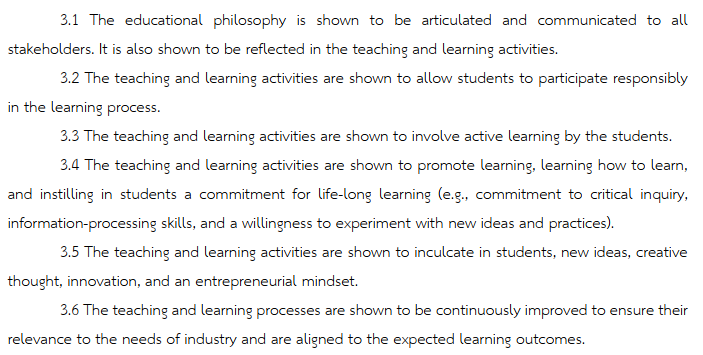
3.1 The educational philosophy is shown to be articulated and communicated to all stakeholders. It is also shown to be reflected in the teaching and learning activities.
Operational Result
The M.Ed.-LMS programme has a clearly articulated educational philosophy that underpins all its teaching and learning activities and is systematically communicated to all stakeholders through multiple channels.
Philosophy Statement
- The programme’s educational philosophy is stated as: “Learning combined with practice in the real educational context will be the most authentic and beneficial learning for learners. It will create leaders in learning management science who can guide the teaching profession and apply the knowledge gained to develop real-world work.”
- This philosophy is grounded in experiential and constructivist learning theory, asserting that the integration of theoretical knowledge with authentic professional practice constitutes the most meaningful form of graduate learning.
- The philosophy is formally documented in the LMS Curriculum 2020 and the Revised LMS Curriculum 2025, positioning it as the foundational rationale for all programme design, teaching approach, and assessment decisions.
Communication to All Stakeholders
- The educational philosophy is published on the Faculty of Education website (https://facultyofeducation.net) and the Graduate Programme website (https://drsuphak.wixsite.com/graduateschooledstic/copy-of-grad-dip-english), making it publicly accessible to prospective students, partner schools, employers, and the wider community.
- The philosophy is presented verbally and in writing at the annual Orientation Session for each incoming student cohort, ensuring all students understand the philosophical basis of their programme from the outset.
- It is embedded in all course syllabi through the teaching philosophy section, ensuring that every course instructor communicates the philosophy’s implications to students at the course level.
- The PLO Summary Presentation (Gamma.app) and the Approved Curriculum Presentation to the University Council (27 February 2025) include the philosophy statement, confirming it has been formally communicated to institutional leadership and governance stakeholders.
- External stakeholders — including partner schools, the Teacher Council of Thailand (Khurusapha), and PLC Center participants — are informed of the programme philosophy through placement orientation documents, network meetings, and the Faculty’s publicly accessible digital resources.
Reflection in Teaching and Learning Activities
- The philosophy of learning through real-world practice is operationalised through the Work-Integrated Learning (WIL) component, in which students undertake supervised professional placements at partner schools. This is the most direct expression of the philosophy in the teaching and learning architecture.
- Seminars are structured as practice-embedded reflection sessions, requiring students to connect theoretical course content to real professional challenges encountered in schools and educational settings.
- Case-based learning, action research projects, and school-based inquiry tasks are employed across multiple courses to ensure that all learning activities are anchored in authentic educational contexts rather than abstract theory alone.
- The e-Portfolio Assessment requires students to document how each learning experience — across courses and field placements — has contributed to their professional growth, reinforcing the philosophy’s emphasis on practice-connected, reflective learning.
- The PLC Center for Strengthening (https://www.edtrsupsf.com) activities bring students into contact with practising teachers and school leaders, further embedding the philosophy of authentic, context-connected learning into the co-curricular dimension of the programme.
Evidence
| Evidence ID | Evidence Name | Description / Source |
|---|---|---|
| 3.1-1 | LMS Curriculum 2025 — Educational Philosophy Section | Official programme document containing the formally approved educational philosophy statement. Available at the programme website. |
| 3.1-2 | Graduate Programme Website — Philosophy and Mission Page | Publicly accessible webpage communicating the programme philosophy to all external stakeholders. https://drsuphak.wixsite.com/graduateschooledstic/copy-of-grad-dip-english |
| 3.1-3 | Approved Curriculum Presentation to University Council (27 Feb 2025) | Institutional presentation including the philosophy statement, confirming communication to governance stakeholders. https://gamma.app/docs/The-Masters-Degree-Program-in-Learning-Management-Science |
| 3.1-4 | Orientation Session Minutes and Handout Package (Batches 2023–2025) | Records confirming that the educational philosophy was formally presented and distributed to incoming students at each annual orientation. |
| 3.1-5 | Course Syllabi Collection — Teaching Philosophy Section | All course syllabi contain a section communicating how the programme philosophy is reflected in that course’s teaching and learning approach. |
| 3.1-6 | WIL / Internship Programme Documentation | Documentation of the professional practicum component demonstrating how the philosophy of practice-integrated learning is operationalised as a core teaching activity. https://drsuphak.wixsite.com/graduateschooledstic/about-4 |
| 3.1-7 | PLC Center Activity Reports (TRSU-PSF) | Records of PLC Center activities demonstrating how the philosophy of authentic, community-connected learning is reflected in the programme’s co-curricular teaching activities. https://www.edtrsupsf.com |
3.2 The teaching and learning activities are shown to allow students to participate responsibly in the learning process.
Operational Result
The M.Ed.-LMS programme deliberately designs its teaching and learning activities to cultivate student ownership of, and responsible participation in, the learning process — recognising that graduate-level professional education requires learners to be active, accountable contributors rather than passive recipients.
Student Responsibility in Seminar-Based Learning
- Seminars are the primary teaching mode for most theoretical and applied courses. Students are required to prepare readings and materials in advance, lead seminar discussions on assigned topics, and contribute substantive, evidence-based arguments to group deliberations — placing direct responsibility on each student for the quality of collective learning.
- The Semester Seminar system requires every student to present an integrated synthesis of their semester’s learning to a faculty panel and peer audience, demanding personal accountability for demonstrating understanding and growth.
Responsible Participation Through Research and Inquiry
- Students are required to conduct original research as part of their thesis (Plan A) or independent study (Plan B), which demands self-directed problem identification, research design, data collection, and scholarly writing — all expressions of responsible, autonomous participation in the knowledge-building process.
- Research workshops and research proposal seminars require students to present, defend, and refine their research plans before peers and advisors, fostering a culture of intellectual responsibility and academic integrity.
Self-Directed Learning and Academic Accountability
- Each course syllabus specifies the student’s individual responsibilities regarding preparation, assignment submission, and participation standards. Students are required to complete independent reading, reflection, and task preparation outside contact hours, with clear assessment weightings for participation quality.
- The e-Portfolio Assessment system places direct responsibility on the student to curate, organise, and reflect on evidence of their own learning across the programme, requiring ongoing self-assessment and self-direction that develops responsible learning habits.
Professional Responsibility in WIL Contexts
- During the WIL professional practicum, students take direct responsibility for planning and delivering learning management activities in real school settings, under the supervision of experienced school-based mentors. This requires students to exercise professional judgment, respond to real learner needs, and reflect critically on their own performance.
- Internship assessment rubrics include specific criteria for professional responsibility, punctuality, initiative, and the ability to manage one’s own professional conduct — embedding responsible participation as an assessable graduate attribute.
Google Classroom and LMS-TRSU Accountability
- The use of Google Classroom for each cohort’s Monitoring Room and the LMS-TRSU platform (https://lms.trsu.ac.th) creates structured digital learning environments in which student participation, submission records, and engagement are trackable and form part of the learning accountability system.
Evidence
| Evidence ID | Evidence Name | Description / Source |
|---|---|---|
| 3.2-1 | Course Syllabi — Participation and Responsibility Assessment Criteria | All course syllabi include explicit criteria for student participation responsibility, including preparation, discussion contribution, and assignment accountability. |
| 3.2-2 | Semester Seminar Guidelines and Evaluation Rubrics | Documents specifying student presentation responsibilities at end-of-semester seminars, including evaluation criteria for personal ownership of learning demonstrated. |
| 3.2-3 | Thesis and Independent Study Guidelines | Documents specifying student responsibilities in conducting and presenting original research as the capstone expression of responsible self-directed learning. Available at https://drsuphak.wixsite.com/graduateschooledstic/about-3 |
| 3.2-4 | Portfolio Assessment Guideline — Self-Assessment and Reflection Requirements | Section of the e-portfolio guideline requiring students to self-assess and reflect on their learning, directly building responsible learner habits. Available at the programme website. |
| 3.2-5 | Internship Assessment Rubric — Professional Responsibility Criteria | WIL assessment rubric containing specific criteria for professional responsibility, initiative, and self-directed conduct during the practicum placement. |
| 3.2-6 | LMS-TRSU and Google Classroom Participation Records | Digital platform records showing student engagement, submission tracking, and participation accountability across all programme courses. https://lms.trsu.ac.th |
3.3 The teaching and learning activities are shown to involve active learning by the students.
Operational Result
Active learning is the foundational pedagogical approach of the M.Ed.-LMS programme. Rather than relying on didactic knowledge transmission, the programme employs a diverse and purposeful set of active learning strategies across all courses and programme components.
Seminar and Discussion-Based Active Learning
- All core and elective courses are delivered primarily through seminar formats in which students engage as active participants rather than passive listeners. Students are required to present, debate, question, and critique ideas in structured academic discussions facilitated by lecturers.
- Peer learning groups and collaborative study activities are embedded in course designs, requiring students to co-construct understanding through dialogue and mutual challenge.
Problem-Based and Case-Based Learning
- Multiple courses employ case-based learning in which students analyse complex real-world educational scenarios, diagnose problems, and develop evidence-based solutions. This requires active cognitive engagement rather than passive reception of information.
- Action research tasks within courses require students to identify a professional problem in their own or an observed educational context, design an investigative approach, and present findings — exemplifying active, inquiry-driven learning.
Research as Active Learning
- The thesis and independent study requirements position research as the highest form of active learning in the programme, demanding that students actively generate new knowledge rather than simply receive and reproduce existing knowledge.
- Research proposal seminars, in which students present and defend their research designs before faculty and peers, are structured as active learning events requiring preparation, presentation, response, and revision.
Work-Integrated Learning as Active Learning
- The WIL professional practicum is an extended, authentic active learning experience in which students design, implement, evaluate, and reflect on actual learning management activities in real school contexts. Students are not observers but active educational practitioners under supervision.
- The STIC-Schools Network and U-Schools Mentoring activities (https://suphak1954.wixsite.com/mysite) involve students in active engagement with school communities, extending active learning beyond the classroom and into professional networks.
Technology-Enhanced Active Learning
- The LMS-TRSU platform (https://lms.trsu.ac.th) supports active learning through online discussion forums, collaborative document spaces, and interactive assignment submission and feedback processes.
- Students use digital tools — including Google Classroom, presentation platforms (Gamma.app, Canva), and research databases — to actively produce and share learning artefacts throughout the programme.
- The e-Portfolio system is itself an active learning tool, requiring students to continuously curate, annotate, and reflect on their learning evidence rather than passively receiving assessment outcomes.
Co-Curricular Active Learning
- PLC Centre sessions (https://www.edtrsupsf.com) involve students in collaborative professional learning communities with practising teachers and school leaders, providing active learning experiences beyond formal coursework.
- Foundation Strengthening and Character Strengthening activities provide structured co-curricular active learning experiences that develop the professional characteristics of the PLO dimension.
Evidence
| Evidence ID | Evidence Name | Description / Source |
|---|---|---|
| 3.3-1 | Course Syllabi — Active Learning Methods Section | All course syllabi specify the active learning methods employed, including seminars, case-based learning, group projects, and inquiry tasks. |
| 3.3-2 | Semester Seminar Records and Presentation Materials | Records of end-of-semester seminars at which students actively present, discuss, and defend their integrated learning. |
| 3.3-3 | WIL / Internship Documentation and Supervision Records | Documentation of the professional practicum as an extended active learning experience in authentic educational settings. https://drsuphak.wixsite.com/graduateschooledstic/about-4 |
| 3.3-4 | LMS-TRSU Platform — Course Activity Records | Digital records of student active participation in online learning activities, discussion forums, and collaborative tasks. https://lms.trsu.ac.th |
| 3.3-5 | Research Proposal Seminar Records | Records of research proposal presentation sessions demonstrating active learning through inquiry design, peer critique, and academic defence. |
| 3.3-6 | PLC Center Participation Records (TRSU-PSF) | Records of student involvement in PLC Center activities as active co-learners alongside practising teachers. https://www.edtrsupsf.com |
| 3.3-7 | Student e-Portfolio Examples | Publicly accessible example portfolios demonstrating active learning artefacts produced by students across courses and field placements. https://drsuphak.wixsite.com/graduateschooledstic/about-7 |
3.4 The teaching and learning activities are shown to promote learning, learning how to learn, and instilling in students a commitment for life-long learning (e.g., commitment to critical inquiry, information-processing skills, and a willingness to experiment with new ideas and practices).
Operational Result
The M.Ed.-LMS programme explicitly designs its teaching and learning activities to develop not only subject knowledge and professional competency but also the metacognitive skills, critical inquiry habits, and intellectual dispositions that sustain lifelong learning in the teaching profession.
Developing Learning How to Learn
- The programme’s educational research methodology courses teach students the systematic processes of inquiry, evidence evaluation, and knowledge validation — foundational metacognitive tools that are transferable to any professional learning challenge throughout the student’s career.
- The thesis and independent study requirements require students to develop and demonstrate a complete, self-directed research cycle — from problem identification to knowledge synthesis and dissemination — equipping them with the process skills for independent knowledge-building beyond the programme.
- Reflective practice is embedded as a structural requirement across multiple courses and in the e-Portfolio system. Students are required to critically examine their own assumptions, learning processes, and professional development trajectories, developing the habit of metacognitive self-monitoring that characterises lifelong learners.
Promoting Critical Inquiry
- All seminar-based teaching activities require students to question, critique, and evaluate theoretical claims and professional practices rather than accept them uncritically. Faculty are required to model and scaffold critical inquiry as a professional disposition.
- Journal clubs and reading seminars require students to engage with current scholarly literature, evaluating research quality, methodological rigour, and practical implications — developing habits of critical information processing applicable throughout professional life.
- Students in both Plan A and Plan B are required to critically review existing literature in their area of study, developing systematic literature review skills that form the foundation of professional self-directed learning.
Information Processing and Digital Literacy
- The programme’s ICT competency requirements, embedded in the Skills PLO dimension, ensure that students develop proficiency in accessing, evaluating, and using information from digital research databases, open educational resources, and professional networks.
- Training in the use of academic databases and digital research tools is integrated into the research methodology curriculum, equipping students to independently access current knowledge throughout their careers.
Commitment to Lifelong Professional Learning
- The PLC Center for Strengthening (https://www.edtrsupsf.com) models lifelong professional learning as an institutional practice, inviting students to participate alongside experienced teachers who are themselves engaged in continuous professional development.
- The STIC-Schools Network and U-Schools Mentoring activities demonstrate to students that professional learning is a career-long, community-embedded practice rather than a programme-specific phase.
- Graduate follow-up activities, including alumni events and continued participation in the Faculty’s professional learning network, extend the lifelong learning culture beyond graduation.
- The Characteristics PLO dimension of the Revised Curriculum 2025 explicitly includes a lifelong learning disposition as a graduate attribute, ensuring that the commitment to continuous professional growth is assessed and not merely aspirational.
Evidence
| Evidence ID | Evidence Name | Description / Source |
|---|---|---|
| 3.4-1 | Course Syllabi — Research Methodology and Critical Inquiry Courses | Syllabi for research methodology and related courses demonstrating how learning-how-to-learn competencies are formally taught and assessed. |
| 3.4-2 | Portfolio Assessment Guideline — Reflective Practice Requirements | Section specifying the reflective learning requirements embedded in the e-portfolio, developing metacognitive lifelong learning habits. Available at the programme website. |
| 3.4-3 | Thesis and Independent Study Guidelines | Documents demonstrating the self-directed research cycle required of all graduates as a lifelong learning competency. https://drsuphak.wixsite.com/graduateschooledstic/about-3 |
| 3.4-4 | LMS Curriculum 2025 — Characteristics PLO Dimension | Curriculum document section specifying the lifelong learning disposition as an assessed graduate attribute in the Characteristics PLO dimension. |
| 3.4-5 | PLC Center Participation Records and Reports | Records demonstrating student involvement in community-based professional lifelong learning activities alongside practising teachers. https://www.edtrsupsf.com |
| 3.4-6 | Graduate Follow-Up Survey Report and Alumni Engagement Records | Annual reports documenting graduates’ continued professional learning engagement, providing evidence that the programme’s lifelong learning orientation transfers to professional practice. |
| 3.4-7 | ICT and Digital Literacy Integration Records (Course Materials) | Course materials and LMS activity records demonstrating ICT-based information processing skill development as a lifelong learning enabler. https://lms.trsu.ac.th |
3.5 The teaching and learning activities are shown to inculcate in students new ideas, creative thought, innovation, and an entrepreneurial mindset.
Operational Result
The M.Ed.-LMS programme actively cultivates creative and innovative thinking in its students through purposefully designed teaching and learning activities that challenge conventional assumptions, reward original thinking, and develop the mindset of educational innovators and leaders.
Fostering New Ideas and Creative Thought
- The programme’s philosophy of learning management science as a leadership discipline explicitly positions graduates as agents of educational change rather than implementers of received practice, establishing a foundational expectation that students will generate, not merely apply, new ideas.
- Creative instructional design projects, embedded in the learning management and instructional design courses, require students to design original, evidence-based learning experiences for their target educational contexts — demanding creative problem-solving and inventive application of pedagogical theory.
- Research seminars are structured to celebrate original research questions and novel conceptual frameworks, rewarding intellectual courage and the willingness to explore unconventional educational problems.
Innovation in Learning Management
- The programme’s emphasis on technology-enhanced learning management provides a consistent arena for creative and innovative application. Students are required to design, prototype, and evaluate technology-integrated learning solutions relevant to their professional contexts — activities that inherently require innovative thinking.
- The LMS-TRSU and Future document (https://drsuphak.wixsite.com/graduateschooledstic/about-5-1) articulates the programme’s vision for preparing graduates who are pioneers in learning management innovation in Thai education and beyond.
- Guest lectures from innovative educational practitioners, school leaders, and technology specialists expose students to real-world models of creative and innovative professional practice in education.
Entrepreneurial Mindset
- An entrepreneurial orientation in educational leadership — the ability to identify unmet learning needs, design responsive solutions, secure resources, and sustain educational improvement initiatives — is developed through the programme’s project-based learning activities and the school-based action research component.
- The STIC-Schools Network and the U-Schools Mentoring Programme involve students in collaborative educational improvement projects with schools, providing authentic contexts in which students must exercise initiative, resourcefulness, and creative problem-solving to address real school development challenges.
- Students are encouraged to conceptualise their thesis or independent study research around innovative educational solutions with practical applicability, fostering the habit of connecting original thinking to real-world value creation — a core dimension of the entrepreneurial mindset.
Creativity in Research and Scholarship
- The programme’s research culture, nurtured through research workshops, thesis supervision, and the research seminar series, rewards methodological creativity and theoretical innovation, developing students’ confidence to propose and defend original scholarly contributions.
- Students are required to present their research and project work using creative, professional-quality multimedia presentations (Gamma.app, Canva, PowerPoint), developing both communicative creativity and digital innovation skill.
Evidence
| Evidence ID | Evidence Name | Description / Source |
|---|---|---|
| 3.5-1 | Instructional Design Course Syllabi and Project Briefs | Course syllabi and assignment briefs requiring students to design original, creative, and innovative learning management solutions as assessed learning activities. |
| 3.5-2 | LMS and the Future Document | Programme vision document articulating the expectation that graduates will be educational innovators and leaders. https://drsuphak.wixsite.com/graduateschooledstic/about-5-1 |
| 3.5-3 | Student Research Seminar Presentations (Sample Collection) | Sample student research presentations demonstrating original, creative, and innovative research questions and conceptual frameworks developed through the programme. |
| 3.5-4 | Guest Lecture Records and Speaker Profiles | Records of guest lectures by innovative educational practitioners and school leaders, providing student exposure to real-world models of educational innovation. |
| 3.5-5 | STIC-Schools Network Project Records | Documentation of school improvement projects in which students exercised initiative, creative problem-solving, and entrepreneurial educational leadership. https://suphak1954.wixsite.com/mysite |
| 3.5-6 | Student Creative Presentation Portfolio (Gamma.app / Canva Examples) | Sample student multimedia presentations demonstrating creative communication and innovative professional expression developed through the programme’s teaching activities. |
| 3.5-7 | Thesis and Independent Study Titles and Abstracts | Collection of thesis and independent study titles and abstracts demonstrating the original, innovative, and creative nature of student-generated research within the programme. |
3.6 The teaching and learning processes are shown to be continuously improved to ensure their relevance to the needs of industry and are aligned to the expected learning outcomes.
Operational Result
The M.Ed.-LMS programme has an established, data-driven continuous improvement cycle for its teaching and learning processes, ensuring that they remain relevant to the evolving needs of the Thai education sector and aligned to the programme’s PLOs.
Established Improvement Procedure
- The Programme Monitoring Calendar schedules an annual structured review of all teaching and learning processes, including assessment of teaching method effectiveness, student learning outcome achievement, and stakeholder satisfaction with the relevance of learning experiences.
- The Faculty’s Internal Quality Assurance (IQA) system collects, analyses, and reports data on teaching and learning quality indicators at the end of each academic year. IQA findings are reviewed by the Faculty Quality Assurance Committee and trigger improvement actions where gaps are identified.
- The Improvement Plan 2566–2568 (https://facultyofeducation.net/improvement-plan-2021/) documents specific, time-bound actions to improve teaching and learning processes based on IQA data, stakeholder feedback, and PLO attainment evidence, providing the implementation framework for continuous improvement.
Data Sources for Improvement
- Student feedback on teaching and learning quality is collected through end-of-course evaluations and the annual student exit survey, providing course-level and programme-level data on pedagogical effectiveness and relevance.
- Practicum supervisor feedback from partner schools provides external data on the practical relevance of the programme’s teaching and learning activities to real professional contexts, highlighting gaps between programme learning and workplace requirements.
- Graduate follow-up survey data provides post-graduation evidence of whether the teaching and learning processes effectively prepared graduates for professional practice, informing both curriculum and pedagogical decisions.
- Faculty peer review and observation processes, in which lecturers observe and provide feedback on each other’s teaching, support continuous professional improvement in pedagogical quality.
Alignment of Improvement Actions to PLOs
- All improvement actions in teaching and learning processes are evaluated against the PLO–CLO Alignment Matrix to ensure that changes enhance rather than disrupt PLO attainment. Any proposed teaching method change is reviewed by the programme committee for its PLO impact before implementation.
- The Revised Curriculum 2025, including its restructured teaching and learning approach, represents the most significant outcome of the continuous improvement cycle, responding to accumulated evidence of the need for stronger WIL integration, ICT-enhanced pedagogy, and more explicit PLO-aligned assessment.
Industry Relevance Maintenance
- Continuous engagement with the PLC Center for Strengthening (https://www.edtrsupsf.com), the STIC-Schools Network (https://suphak1954.wixsite.com/mysite), and partner school networks ensures that teaching and learning processes reflect current professional practice in Thai schools, maintaining industry relevance between formal curriculum review cycles.
- Invited practitioners from schools and educational organisations participate as guest lecturers, co-facilitators, and practicum supervisors, continuously infusing current professional knowledge into the programme’s teaching and learning environment.
- The Faculty’s participation in the ONESQA Network (https://suphak3.wixsite.com/my-site-3) and engagement with national education policy developments ensures that teaching and learning improvements are responsive to the broader national educational landscape.
Evidence
| Evidence ID | Evidence Name | Description / Source |
|---|---|---|
| 3.6-1 | Programme Monitoring Calendar | Annual schedule of teaching and learning process review activities, confirming that improvement is a structured, recurring institutional procedure. https://facultyofeducation.net/ |
| 3.6-2 | IQA Annual Reports (AY 2560–2565) | Faculty Internal Quality Assurance reports providing the data basis for teaching and learning improvement actions. https://facultyofeducation.net/ (IQA Database section) |
| 3.6-3 | Improvement Plan 2566–2568 | Faculty improvement plan specifying time-bound actions to improve teaching and learning processes based on IQA and stakeholder data. https://facultyofeducation.net/improvement-plan-2021/ |
| 3.6-4 | End-of-Course Student Evaluation Reports | Course-level student feedback reports providing quantitative and qualitative data on teaching effectiveness and learning relevance, used to drive improvement actions. |
| 3.6-5 | Graduate Follow-Up Survey Reports (Annual) | Post-graduation data on the effectiveness of teaching and learning processes in preparing graduates for professional practice, informing continuous improvement. |
| 3.6-6 | Practicum Supervisor Feedback Reports | External practitioner feedback on the relevance of programme teaching to workplace requirements, providing industry-grounded improvement data. |
| 3.6-7 | Faculty Peer Teaching Review Records | Records of lecturer peer observation and review processes supporting continuous pedagogical quality improvement at the individual teaching level. |
SOME OF THE COURSE SUBJECT EXAMPLES: TEACHING AND LEARNING APPROACH
Standard 3.1
The educational philosophy is shown to be articulated and communicated to all stakeholders. It is also shown to be reflected in the teaching and learning activities.
Teaching Strategies and Alignment with Assignments
- Philosophy Statement Integration: The programme philosophy — “Learning combined with practice in the real educational context will be the most authentic and beneficial learning for learners” — is embedded in every course syllabus and communicated at orientation. All assignments in AY 2025 were designed to reflect this philosophy by grounding learning tasks in real educational contexts rather than abstract exercises.
- Work-Integrated Learning (WIL) as Philosophy Expression: Assignment 1 (LMS Evaluation and Curriculum Alignment Audit, due 10 August 2025) directly expresses the programme philosophy by requiring students to evaluate a real LMS against real curriculum objectives — authentic professional practice, not simulation.
- Real-World Problem Orientation: Assignment 5 (Group Presentation — Digital Technology Problems, posted 23 June 2025) required students to identify and present on actual implementation problems in digital technology in Thai education — grounding the learning task in the real professional context the philosophy demands.
- Historical Contextualisation of Practice: Assignment 3 (History of Educational Technology Timeline Creation, due 13 July 2025) situated students’ professional learning within the historical development of the field, building the contextual knowledge that the philosophy of informed professional leadership requires.
- Digital Platform as Philosophy Infrastructure: The use of Google Classroom, Seesaw (Assignment 4, posted 1 September 2025), and LMS-TRSU as learning platforms communicates the programme’s philosophy of technology-integrated professional education to students, partners, and external stakeholders by making digital learning management a lived experience rather than a studied subject.
- Stakeholder Communication Channels: The programme philosophy is published on the Faculty of Education website (https://facultyofeducation.net), the Graduate Programme website, and communicated through orientation materials and the Gamma.app PLO presentation — ensuring all stakeholders have access to the articulated philosophy that the AY 2025 assignments operationalise.
- Curriculum Evaluation as Philosophy Validation: Assignment 14 (Evaluation of Curriculum — Past 10 Years) required students to evaluate whether real curriculum changes over a decade achieved their intended outcomes — an activity that enacts the programme philosophy of reflective, evidence-based professional practice.
Evidence Table
| Evidence ID | Evidence Name | Description | Link / Source |
| 3.1-1 | Programme Philosophy Statement (LMS Curriculum 2025) | Formal statement of the educational philosophy embedded in the approved curriculum document | https://4fc3e7f5-50a0-4f9f-9bd6-062e287fe7a7.usrfiles.com/ugd/4fc3e7_34b7029bac654c7c9221065a4333306e.pdf |
| 3.1-2 | Assignment 1: LMS Evaluation and Curriculum Alignment Audit | Real-world evaluation task reflecting philosophy of authentic practice-based learning | Google Classroom: https://classroom.google.com/c/NjM0NTc4NDM5NzU1 |
| 3.1-3 | Assignment 5: Group Presentation — Digital Technology Problems | Real educational problem analysis reflecting philosophy of learning in real educational contexts | Google Classroom: https://classroom.google.com/c/NjM0NTc4NDM5NzU1 |
| 3.1-4 | Assignment 3: History of Educational Technology Timeline | Contextualises professional learning within real history of the discipline | Google Classroom: https://classroom.google.com/c/NjM0NTc4NDM5NzU1 |
| 3.1-5 | Faculty of Education Website (Philosophy Publication) | Public communication of programme philosophy to all stakeholders | https://facultyofeducation.net |
| 3.1-6 | Graduate Programme Website (Philosophy Statement) | Online public access to programme philosophy for prospective students and partners | https://drsuphak.wixsite.com/graduateschooledstic/copy-of-grad-dip-english |
| 3.1-7 | PLO Summary Presentation (Gamma.app) | Publicly accessible PLO and philosophy presentation communicating philosophy to all stakeholders | https://gamma.app/docs/zmozrc29h4jkhqt |
| 3.1-8 | Seesaw Assignment: Digital Tools in Assessment | Digital platform use reflecting philosophy of technology-integrated professional learning | Posted 1 Sep 2025 via Google Classroom |
| 3.1-9 | Course Syllabi (TQF3 Documents: 142 203, 142 304, 142 402) | Syllabi embedding philosophy in CLOs, teaching methods, and assessment design | https://mis.trsu.ac.th (AY 2568) |
Standard 3.2
The teaching and learning activities are shown to allow students to participate responsibly in the learning process.
Teaching Strategies and Alignment with Assignments
- Think-Pair-Share (TPS) Method: TPS was systematically deployed across core courses in AY 2025. In the Think phase, every student independently formulates a response — no passive attendance is possible. In the Pair phase, students take social responsibility for productive dialogue with a peer. In the Share phase, students take communicative responsibility for presenting synthesised thinking to the class. Assignment 10 (Student Engagement and Understanding, posted 25 August 2024) required students to submit individual engagement reflections, creating a written accountability record for TPS participation.
- Group Presentations with Individual Accountability: Assignment 5 (Group Presentation — Digital Technology Problems), Assignment 12–13 (Group Presentation, 11 August 2024), and Assignment 9 (Group Presentation — Sampling Techniques, 15 September 2024) each required students to collectively research, prepare, and deliver professional presentations. Every group member bore responsibility for their share of the research and for the coherence of the group’s public performance.
- Peer Review Evaluation System: Assignment 12 (Submit Your Peer Review Evaluation — Group Presentation Evaluation Form, due 17 August 2024) made students formal evaluators of their peers’ work. Students were responsible for producing fair, structured, evidence-based feedback — making them accountable not only for their own learning but for the quality of feedback they contributed to their classmates’ development.
- Sequential Research Proposal Development: The research proposal sequence across Assignments 6-4 (Research Types, November 2024), 6-6 (Research Titles, November 2024), 6-5 (Measurement Design, January 2025), and 6-1 (Power Test, February 2025) placed sustained temporal and intellectual responsibility on students across a four-month independent scholarly development process.
- Deadline-Governed Submission Structure: Sixteen of eighteen AY 2025 assignments carried explicit due dates with timestamped Google Classroom submissions — creating an objective, non-negotiable record of each student’s temporal responsibility for their own academic progress.
- Academic Article and Evaluation Writing: Assignment 2 (Global Curriculum Comparison and Digital Integration, due 23 July 2025) and Assignment 14 (Evaluation of Curriculum — Past 10 Years) required students to produce independent, original, structured academic writing — holding each student responsible for the quality of their own intellectual contribution without the option of sharing credit.
- Self-Directed Preparation Requirement: The recurring book/preparation assignment (“Prepare Yourselves Very Well Before the Class”) established the expectation of independent pre-class study responsibility as a programme norm — communicating that class time is for application and discussion, not for first exposure to content.
Evidence Table
| Evidence ID | Evidence Name | Description | Link / Source |
| 3.2-1 | Assignment 1: LMS Evaluation and Curriculum Alignment Audit | Professional-level individual evaluation task requiring sustained intellectual and ethical responsibility | Due 10 Aug 2025; Google Classroom: https://classroom.google.com/c/NjM0NTc4NDM5NzU1 |
| 3.2-2 | Assignment 5: Group Presentation — Digital Technology Problems | Collaborative presentation requiring shared social and intellectual responsibility | Posted 23 Jun 2025; Google Classroom: https://classroom.google.com/c/NjM0NTc4NDM5NzU1 |
| 3.2-3 | Assignment 12: Peer Review Evaluation Form Submission | Formal peer evaluation requiring ethical and social responsibility for classmates’ learning | Due 17 Aug 2024; Google Classroom: https://classroom.google.com/c/ODE2MzgyNTc2NTg0 |
| 3.2-4 | Assignment 13: Group Presentation (11 Aug 2024) | Group preparation and delivery requiring collective professional responsibility | Due 17 Aug 2024; Google Classroom: https://classroom.google.com/c/ODE2MzgyNTc2NTg0 |
| 3.2-5 | Assignment 9: Group Presentation — Sampling Techniques | Peer-teaching format requiring highest level of social accountability and preparation responsibility | Posted 15 Sep 2024; Google Classroom: https://classroom.google.com/c/ODE2MzgyNTc2NTg0 |
| 3.2-6 | Assignment 6-6: Creating Research Titles (min. 5) | Creative independent research ideation requiring individual intellectual initiative | Due 15 Nov 2024; Google Classroom: https://classroom.google.com/c/ODE2MzgyNTc2NTg0 |
| 3.2-7 | Assignment 6-5: Measurement Design for a Research Project | Graduate-level methodological responsibility for independent research planning | Due 3 Jan 2025; Google Classroom: https://classroom.google.com/c/ODE2MzgyNTc2NTg0 |
| 3.2-8 | Assignment 10: Student Engagement and Understanding | TPS-linked engagement reflection documenting individual participation accountability | Posted 25 Aug 2024; Google Classroom: https://classroom.google.com/c/ODE2MzgyNTc2NTg0 |
| 3.2-9 | Assignment 14: Evaluation of Curriculum — Past 10 Years | Extended independent scholarly evaluation requiring sustained temporal and intellectual responsibility | Google Classroom: https://classroom.google.com/c/ODE2MzgyNTc2NTg0 |
| 3.2-10 | Assignment 2: Global Curriculum Comparison and Digital Integration | Independent analytical writing in English requiring full individual intellectual accountability | Due 23 Jul 2025; Google Classroom: https://classroom.google.com/c/NjM0NTc4NDM5NzU1 |
Standard 3.3
The teaching and learning activities are shown to involve active learning by the students.
Teaching Strategies and Alignment with Assignments
- Think-Pair-Share (TPS) as Core Active Learning Structure: TPS eliminated passive attendance from every session it was deployed. The compulsory Think phase demanded active individual cognition; the Pair phase demanded active collaborative construction; the Share phase demanded active public intellectual contribution. No student could simply observe — every TPS round required active engagement from every participant.
- Problem-Based Group Presentations: Assignment 5 (Group Presentation — Digital Technology Problems) required students to actively research, analyse, synthesise, and publicly defend original positions on real educational technology problems — engaging cognitive, communicative, and professional competencies simultaneously in an active, performance-based learning event.
- Peer-Teaching Through Sampling Techniques Presentation: Assignment 9 (Group Presentation — Sampling Techniques, 15 September 2024) placed students in the role of teacher — the most active learning position available, requiring mastery of content to a level sufficient to explain, demonstrate, and answer questions about it for peers.
- Timeline Creation as Active Knowledge Construction: Assignment 3 (History of Educational Technology Timeline Creation, due 13 July 2025) required students to actively research, select, sequence, and visually represent historical developments — a constructive creative task demanding active engagement with the history of the field rather than passive reading of a provided account.
- Live Digital Tool Exploration (Seesaw): Assignment 4 (Seesaw Assignment, posted 1 September 2025) required students to actively use a real educational technology platform — navigating its features, applying it to assessment concepts, and documenting their engagement through the platform’s interactive comment functionality. Active digital tool use, not passive observation, was the assessment mechanism.
- Case Study Analysis with Exercise Completion: Assignment 6-2 (Please Study the Case or Example and Do the Exercise at the End of the Post, due 13 February 2025) required students to actively engage with a presented case, apply analytical frameworks, and produce exercise responses — a structured active learning task combining reading comprehension with applied analytical production.
- Research Problem Identification as Active Inquiry: Assignment 6-3 (How Research Examines the Quality of an Innovation, due 8 February 2025) required students to actively interrogate a real research project’s methodology — going beyond passive understanding to active critical examination of how research design choices affect the quality of educational innovation evaluation.
- Authentic Evaluation Audit: Assignment 1 (LMS Evaluation and Curriculum Alignment Audit, due 10 August 2025) engaged students in active professional practice — conducting, not observing, an evaluation — representing the programme’s most demanding active learning task in AY 2025.
Evidence Table
| Evidence ID | Evidence Name | Description | Link / Source |
| 3.3-1 | Assignment 5: Group Presentation — Digital Technology Problems | Active research, synthesis, and public defence of original positions on real EdTech problems | Posted 23 Jun 2025; https://classroom.google.com/c/NjM0NTc4NDM5NzU1 |
| 3.3-2 | Assignment 9: Group Presentation — Sampling Techniques | Peer-teaching role requiring active mastery and knowledge communication | Posted 15 Sep 2024; https://classroom.google.com/c/ODE2MzgyNTc2NTg0 |
| 3.3-3 | Assignment 3: History of Educational Technology Timeline | Active knowledge construction through research, selection, and visual representation | Due 13 Jul 2025; https://classroom.google.com/c/NjM0NTc4NDM5NzU1 |
| 3.3-4 | Assignment 4: Seesaw Assignment — Digital Tools in Assessment | Active live platform engagement with interactive digital assessment tool | Posted 1 Sep 2025; Google Classroom / Seesaw platform |
| 3.3-5 | Assignment 1: LMS Evaluation and Curriculum Alignment Audit | Active professional evaluation practice — conducting an audit, not studying one | Due 10 Aug 2025; https://classroom.google.com/c/NjM0NTc4NDM5NzU1 |
| 3.3-6 | Assignment 6-2: Case Study Exercise | Active case analysis with applied exercise completion requiring engagement beyond reading | Due 13 Feb 2025; https://classroom.google.com/c/ODE2MzgyNTc2NTg0 |
| 3.3-7 | Assignment 6-3: Research Project Study — Innovation Quality | Active critical examination of real research methodology | Due 8 Feb 2025; https://classroom.google.com/c/ODE2MzgyNTc2NTg0 |
| 3.3-8 | Assignment 10: Student Engagement and Understanding | Active TPS participation documentation and engagement reflection submission | Posted 25 Aug 2024; https://classroom.google.com/c/ODE2MzgyNTc2NTg0 |
| 3.3-9 | Assignment 14: Evaluation of Curriculum — Past 10 Years | Active independent scholarly evaluation requiring sustained cognitive engagement | https://classroom.google.com/c/ODE2MzgyNTc2NTg0 |
| 3.3-10 | Google Classroom Platform Records (142 203 and 142 304) | Digital evidence of active student submission, participation, and engagement across AY 2025 | https://classroom.google.com/c/NjM0NTc4NDM5NzU1 and https://classroom.google.com/c/ODE2MzgyNTc2NTg0 |
Standard 3.4
The teaching and learning activities are shown to promote learning, learning how to learn, and instilling in students a commitment for life-long learning (e.g., commitment to critical inquiry, information-processing skills, and a willingness to experiment with new ideas and practices).
Teaching Strategies and Alignment with Assignments
- Research Proposal Sequence as Learning-How-to-Learn Architecture: The four-stage research proposal sequence (Assignments 6-4 → 6-6 → 6-5 → 6-1, November 2024 to February 2025) is the programme’s clearest expression of learning-how-to-learn. Students did not simply study research methodology — they learned to direct their own research development process across four months, making independent decisions about research focus, design, and measurement. This sequence explicitly teaches the metacognitive process of scholarly self-direction.
- Critical Inquiry Through Comparative Analysis: Assignment 2 (Global Curriculum Comparison and Digital Integration, due 23 July 2025) required students to critically examine and compare curriculum frameworks from multiple global educational systems — developing the habit of critical inquiry across diverse evidence sources that is the hallmark of lifelong scholarly practice.
- Information-Processing Skills Through Literature Synthesis: Assignment 6-3 (How Research Examines the Quality of an Innovation) and Assignment 6-2 (Case Study Exercise) required students to read, critically evaluate, and synthesise complex academic research materials — directly developing the information-processing skills that Standard 3.4 identifies as central to lifelong learning.
- Willingness to Experiment with New Ideas — Digital Tool Exploration: Assignment 4 (Seesaw, posted 1 September 2025) required students to independently explore and use an educational technology platform they may not have previously encountered — directly developing the willingness to experiment with new digital tools and practices that is essential to lifelong professional learning in the rapidly evolving EdTech landscape.
- Decade-Long Curriculum Evaluation as Reflective Practice: Assignment 14 (Evaluation of Curriculum — Past 10 Years) required students to reflect systematically on how educational practice has evolved over time and to evaluate its trajectory — developing the reflective learning disposition that is the foundation of lifelong professional improvement.
- Self-Preparation Discipline as Lifelong Learning Habit: The recurring preparation assignment (“Prepare Yourselves Very Well Before the Class”) established the discipline of self-directed pre-learning as a programme norm — directly developing the autonomous information-seeking habit that characterises lifelong learners who do not wait for instruction before engaging with new knowledge.
- Midterm Examination as Formative Self-Assessment Trigger: Assignment 6-10 (Midterm Examination — Curriculum Evaluation Research, due 24 August 2024) provided students with a structured opportunity to assess the state of their own knowledge at the programme’s midpoint — a formative learning milestone that promotes metacognitive awareness of what is known, what is not, and what requires further self-directed study.
- Timeline Creation as Historical Information Literacy: Assignment 3 (History of Educational Technology Timeline, due 13 July 2025) required students to develop historical information literacy by independently researching, verifying, and sequencing the development of EdTech — building the capacity to locate, evaluate, and organise historical information that lifelong learning in any field requires.
Evidence Table
| Evidence ID | Evidence Name | Description | Link / Source |
| 3.4-1 | Assignment 6-6: Creating Research Titles | Creative independent research ideation developing learning-how-to-learn through scholarly self-direction | Due 15 Nov 2024; https://classroom.google.com/c/ODE2MzgyNTc2NTg0 |
| 3.4-2 | Assignment 6-5: Measurement Design for a Research Project | Graduate-level research planning developing metacognitive research self-direction | Due 3 Jan 2025; https://classroom.google.com/c/ODE2MzgyNTc2NTg0 |
| 3.4-3 | Assignment 6-4: Types of Research in Decision-Making | Critical inquiry into research methodology for professional decision-making | Due 7 Nov 2024; https://classroom.google.com/c/ODE2MzgyNTc2NTg0 |
| 3.4-4 | Assignment 6-3: Research Project — Innovation Quality | Information-processing and critical analysis of real research methodology | Due 8 Feb 2025; https://classroom.google.com/c/ODE2MzgyNTc2NTg0 |
| 3.4-5 | Assignment 4: Seesaw — Digital Tools in Assessment | Independent new platform exploration developing willingness to experiment with new practices | Posted 1 Sep 2025; Google Classroom / Seesaw |
| 3.4-6 | Assignment 2: Global Curriculum Comparison and Digital Integration | Critical comparative inquiry across global educational systems developing information literacy | Due 23 Jul 2025; https://classroom.google.com/c/NjM0NTc4NDM5NzU1 |
| 3.4-7 | Assignment 14: Evaluation of Curriculum — Past 10 Years | Reflective longitudinal evaluation developing lifelong professional reflective practice | https://classroom.google.com/c/ODE2MzgyNTc2NTg0 |
| 3.4-8 | Assignment 3: History of Educational Technology Timeline | Historical information literacy and chronological synthesis as lifelong learning foundation | Due 13 Jul 2025; https://classroom.google.com/c/NjM0NTc4NDM5NzU1 |
| 3.4-9 | Self-Preparation Requirement (“Prepare Yourselves Very Well”) | Establishes autonomous pre-class learning discipline as a programme-wide lifelong learning norm | Google Classroom (recurring): https://classroom.google.com/c/ODE2MzgyNTc2NTg0 |
| 3.4-10 | Assignment 6-10: Midterm Examination — Curriculum Evaluation Research | Structured formative self-assessment milestone promoting metacognitive awareness | Due 24 Aug 2024; https://classroom.google.com/c/ODE2MzgyNTc2NTg0 |
Standard 3.5
The teaching and learning activities are shown to inculcate in students, new ideas, creative thought, innovation, and an entrepreneurial mindset.
Teaching Strategies and Alignment with Assignments
- Creative Research Title Generation: Assignment 6-6 (Creating the Research Titles — at least 5, due 15 November 2024) is the most direct evidence of creative thought as an assessed learning activity in AY 2025. Students were required to generate at minimum five original research titles — not select from a provided list, not adapt existing studies, but independently identify new problems worth investigating. This is an exercise in pure creative scholarly ideation, demanding that students think entrepreneurially about the field’s knowledge gaps.
- Digital Technology Innovation Analysis: Assignment 5 (Group Presentation — Digital Technology Problems, posted 23 June 2025) required students not only to identify problems but to develop and publicly defend innovative solutions or alternative approaches to digital technology implementation challenges — directly cultivating creative problem-solving and innovation mindset in the professional context.
- LMS Audit as Innovative Professional Thinking: Assignment 1 (LMS Evaluation and Curriculum Alignment Audit, due 10 August 2025) required students to apply evaluation frameworks innovatively to a technology platform context — generating new insights about the alignment between a real LMS and curriculum objectives, a task that demands creative analytical thinking to produce professionally useful findings rather than generic observations.
- Timeline as Creative Knowledge Curation: Assignment 3 (History of Educational Technology Timeline Creation, due 13 July 2025) required students to make creative curatorial judgments about which developments in EdTech history were most significant, how to represent them visually, and how to connect them to current practice — developing creative information design and knowledge organisation skills.
- New Educational Technology Exploration (Seesaw): Assignment 4 (Seesaw Assignment, posted 1 September 2025) positioned students as innovators exploring a platform new to their practice, evaluating its potential, and contributing original reflections on its educational application — an entrepreneurial mindset activity requiring students to assess a new tool’s value proposition for their professional context.
- Curriculum Evaluation as Innovation Assessment: Assignment 14 (Evaluation of Curriculum — Past 10 Years) required students to assess whether curriculum innovations over a decade were genuinely effective — developing critical evaluative thinking about innovation quality that is the foundation of an evidence-based entrepreneurial mindset. Students who can evaluate past innovation rigorously are better positioned to design future innovation responsibly.
- Global Comparative Thinking as Innovation Stimulus: Assignment 2 (Global Curriculum Comparison and Digital Integration, due 23 July 2025) required students to examine how different national educational systems have approached digital integration innovatively — exposing them to diverse innovation models and stimulating creative thinking about which approaches might be adapted or improved in the Thai educational context.
- Case Study Analysis for Problem-Solving Innovation: Assignment 6-2 (Case Study Exercise, due 13 February 2025) required students to apply innovative analytical thinking to real educational cases — developing the capacity to see problems in new ways and generate creative, context-sensitive solutions rather than applying standard formulas.
Evidence Table
| Evidence ID | Evidence Name | Description | Link / Source |
| 3.5-1 | Assignment 6-6: Creating Research Titles (min. 5) | Most direct creative ideation task — students generate original research problems in the field | Due 15 Nov 2024; https://classroom.google.com/c/ODE2MzgyNTc2NTg0 |
| 3.5-2 | Assignment 5: Group Presentation — Digital Technology Problems | Innovation and creative solution development for real EdTech implementation challenges | Posted 23 Jun 2025; https://classroom.google.com/c/NjM0NTc4NDM5NzU1 |
| 3.5-3 | Assignment 1: LMS Evaluation and Curriculum Alignment Audit | Creative professional evaluation generating new insights about technology-curriculum alignment | Due 10 Aug 2025; https://classroom.google.com/c/NjM0NTc4NDM5NzU1 |
| 3.5-4 | Assignment 4: Seesaw — Digital Tools in Assessment | Entrepreneurial new platform exploration and evaluation of innovation potential | Posted 1 Sep 2025; Google Classroom / Seesaw platform |
| 3.5-5 | Assignment 3: History of Educational Technology Timeline | Creative curatorial judgment in knowledge selection, sequencing, and visual representation | Due 13 Jul 2025; https://classroom.google.com/c/NjM0NTc4NDM5NzU1 |
| 3.5-6 | Assignment 2: Global Curriculum Comparison and Digital Integration | Cross-national innovation exposure stimulating creative adaptation thinking | Due 23 Jul 2025; https://classroom.google.com/c/NjM0NTc4NDM5NzU1 |
| 3.5-7 | Assignment 14: Evaluation of Curriculum — Past 10 Years | Critical evaluation of curriculum innovation effectiveness building evidence-based entrepreneurial judgment | https://classroom.google.com/c/ODE2MzgyNTc2NTg0 |
| 3.5-8 | Assignment 6-2: Case Study — Exercise at End of Post | Creative case-based problem-solving developing innovative analytical reasoning | Due 13 Feb 2025; https://classroom.google.com/c/ODE2MzgyNTc2NTg0 |
| 3.5-9 | Final Examination Section 2 — Task 2.2: AI Tools for Curriculum Research | Students explore and critically evaluate AI tools for curriculum research — live innovation mindset assessment | 5 Oct 2025 Examination; Faculty of Education Records |
| 3.5-10 | Final Examination Section 2 — Task 2.3: Gamified Platforms and XR Tools | Students design mini learning activities using gamified/XR platforms — entrepreneurial EdTech innovation task | 5 Oct 2025 Examination; Faculty of Education Records |
Standard 3.6
The teaching and learning processes are shown to be continuously improved to ensure their relevance to the needs of industry and are aligned to the expected learning outcomes.
Teaching Strategies and Alignment with Assignments
- Annual Assignment Portfolio Review: The AY 2025 assignment portfolio reflects deliberate improvement from prior academic years. The inclusion of Assignment 1 (LMS Evaluation and Curriculum Alignment Audit) and Assignment 4 (Seesaw Platform Engagement) represent new task types introduced in AY 2025 in direct response to the growing demand from partner schools for graduates with practical LMS evaluation competency and hands-on educational technology experience — demonstrating that assignment design is continuously updated to match industry relevance.
- Alignment of Assignment Types to Revised PLOs: Following the approval of the Revised Curriculum 2025 (B.E. 2568) in February 2025, all new assignments introduced in Semester 1 AY 2025 (Assignments 1–5) were designed to align with the revised four-dimension PLO framework (Knowledge, Skills, Ethics, Characters) — demonstrating that teaching and learning activities are continuously realigned to the current PLO architecture.
- Industry-Relevant Task Design: Every assignment in AY 2025 was designed around authentic industry tasks. Assignment 1 mirrors the work of educational evaluators and curriculum specialists; Assignment 2 mirrors the work of international curriculum developers; Assignment 5 mirrors professional technology problem-solving in school administration; the research proposal sequence mirrors the work of educational researchers. This industry-task alignment is not accidental but the product of deliberate, continuous curriculum improvement.
- Digital Platform Modernisation: The introduction of Seesaw as a learning platform alongside Google Classroom in AY 2025 represents a continuous improvement of the programme’s digital learning environment, introducing students to a new educational technology platform with industry application in school assessment management — keeping the programme’s technology-integrated pedagogy current with professional practice.
- Feedback-Driven Assignment Adjustment: The peer evaluation system (Assignment 12) generates cohort-level feedback data that informs the Programme Director’s annual review of assignment quality. Student feedback on presentation criteria, evaluation form design, and assessment fairness contributes to the continuous improvement of subsequent assessment tasks.
- IQA-Linked Teaching Review: The Faculty IQA Database records quality assurance data including teaching quality indicators and student satisfaction with learning activities. The Programme Monitoring Calendar schedules annual review of teaching and learning processes against IQA data — ensuring that the AY 2025 assignment portfolio is not simply repeated but reviewed, evaluated, and improved for AY 2026.
- Research Methodology Updates: The research proposal sequence (Assignments 6-4 through 6-1) was updated in AY 2025 to include a Power Test assignment (Assignment 6-1, due 23 February 2025) — introducing a new methodological sophistication requirement that reflects current best practice in educational research methodology and responds to the programme’s continuous improvement commitment to keeping research teaching aligned with current academic standards.
- Curriculum Evaluation Currency: Assignment 14 (Evaluation of Curriculum — Past 10 Years) is inherently a continuous improvement mechanism: by requiring students to evaluate the last decade of curriculum development, the assignment ensures that teaching content remains connected to current and recent educational developments rather than becoming anchored in outdated examples.
Evidence Table
| Evidence ID | Evidence Name | Description | Link / Source |
| 3.6-1 | LMS Curriculum 2025 (Revised) | New PLO framework (approved 27 Feb 2025) driving continuous realignment of all AY 2025 teaching and learning activities | https://4fc3e7f5-50a0-4f9f-9bd6-062e287fe7a7.usrfiles.com/ugd/4fc3e7_34b7029bac654c7c9221065a4333306e.pdf |
| 3.6-2 | Faculty Operation Plan 2023–2025 (Teaching and Learning Review Targets) | Annual targets for teaching and learning quality improvement driving assignment portfolio redesign | https://facultyofeducation.net/operation-plan/ |
| 3.6-3 | Programme Monitoring Calendar | Annual schedule of teaching and learning process review confirming continuous improvement as institutionalised practice | https://facultyofeducation.net/ |
| 3.6-4 | IQA Database Records (AY 2560–2565) | Longitudinal quality data informing evidence-based improvement of teaching and learning processes | https://facultyofeducation.net/ (IQA Database section) |
| 3.6-5 | Improvement Plan 2566–2568 | Faculty improvement plan specifying teaching and learning enhancement actions with timelines and responsibilities | https://facultyofeducation.net/improvement-plan-2021/ |
| 3.6-6 | Assignment 1: LMS Evaluation and Curriculum Alignment Audit | New AY 2025 task type introduced in response to industry demand for LMS evaluation competency | Due 10 Aug 2025; https://classroom.google.com/c/NjM0NTc4NDM5NzU1 |
| 3.6-7 | Assignment 4: Seesaw Platform Engagement | New platform introduced in AY 2025 representing continuous improvement of digital learning environment | Posted 1 Sep 2025; Google Classroom / Seesaw |
| 3.6-8 | Assignment 6-1: Power Test (Research Methodology) | New methodological rigour requirement added in AY 2025 reflecting current best practice in educational research | Due 23 Feb 2025; https://classroom.google.com/c/ODE2MzgyNTc2NTg0 |
| 3.6-9 | Peer Review Evaluation Form (Assignment 12) | Feedback-generating mechanism whose data informs continuous improvement of assessment task design | Due 17 Aug 2024; https://classroom.google.com/c/ODE2MzgyNTc2NTg0 |
| 3.6-10 | Assignment 14: Evaluation of Curriculum — Past 10 Years | Inherently current task requiring engagement with the most recent decade of curriculum development — continuous content currency mechanism | https://classroom.google.com/c/ODE2MzgyNTc2NTg0 |
| 3.6-11 | Faculty Strategic Plan 2562–2570 | Long-term governance framework mandating continuous improvement of teaching and learning aligned to industry and PLOs | https://facultyofeducation.net/strategic-plan-2560-2563/ |
Self-Assessment
| Requirements | Result | Score |
| 3.1 The educational philosophy is shown to be articulated and communicated to all stakeholders. It is also shown to be reflected in the teaching and learning activities. | / | 1 |
| 3.2 The teaching and learning activities are shown to allow students to participate responsibly in the learning process. | / | 1 |
| 3.3 The teaching and learning activities are shown to involve active learning by the students. | / | |
| 3.4 The teaching and learning activities are shown to promote learning, learning how to learn, and instilling in students a commitment for life-long learning. | / | 1 |
| 3.5 The teaching and learning activities are shown to inculcate in students, new ideas, creative thought, innovation, and an entrepreneurial mindset. | / | 1 |
| 3.6 The teaching and learning processes are shown to be continuously improved to ensure their relevance to the needs of industry and are aligned to the expected learning outcomes. | / | 1 |
| Overall | 5 | |