Criterion 4 – Student Assessment
Criterion
Requirements
Quality level assessment

Result
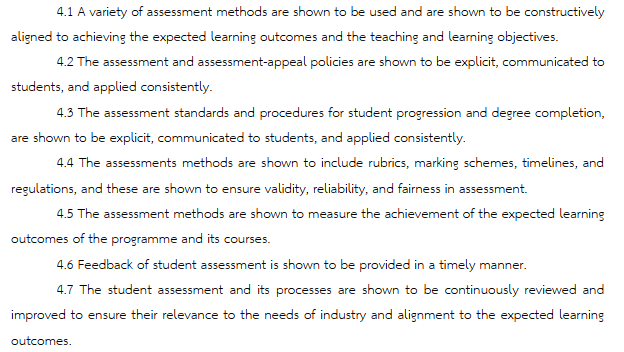
4.1. A variety of assessment methods are shown to be used and are shown to be constructively aligned to achieve the expected learning outcomes and the teaching and learning objectives.
Operational Result
The M.Ed.-LMS programme employs a deliberately varied and constructively aligned assessment system designed to ensure that every Programme Learning Outcome (PLO) and Course Learning Outcome (CLO) is assessed through methods that are appropriate to the nature of the competency being measured and the level of learning expected at the master’s degree level.
The programme’s assessment philosophy is grounded in the principle that no single assessment method can adequately capture the full range of knowledge, skills, ethical dispositions, and professional characteristics that the PLO framework requires graduates to demonstrate. Accordingly, the programme systematically employs multiple assessment types distributed across four broad categories that together address all PLO dimensions.
Written academic assessments include research-based assignments, literature reviews, critical analyses, and reflective research papers. These methods primarily assess the Knowledge PLO dimension, requiring students to demonstrate command of the theoretical and empirical literature in learning management science, the ability to critically evaluate evidence, and the capacity to construct coherent scholarly arguments. Final examinations, where employed, are designed not as knowledge-recall instruments but as integrative tasks requiring students to apply theoretical frameworks to novel professional scenarios.
Performance and product assessments include instructional design projects, curriculum development tasks, learning management system design briefs, and professional development programme proposals. These methods assess the Skills PLO dimension, requiring students to produce professional-standard outputs that demonstrate the ability to translate theoretical knowledge into practical educational interventions. Assessment rubrics for these tasks are explicitly aligned to the CLOs they address and, through those CLOs, to the relevant PLOs.
Oral and presentation assessments include the Semester Seminar presentations, thesis and independent study defences, and WIL practicum reporting presentations. These methods assess oral communication as a generic PLO outcome and simultaneously assess the depth of students’ disciplinary knowledge and professional judgment through the quality of their public reasoning and their responses to critical questioning.
Authentic professional assessments include the WIL practicum evaluation, conducted by school-based supervisors using structured rubrics aligned to the professional teaching competency PLOs. This assessment method is the most direct measure of the Ethics and Characteristics PLO dimensions, as it evaluates student performance in the full complexity of a real educational environment rather than a simulated or controlled task.
The e-Portfolio Assessment serves as the programme’s integrative meta-assessment, drawing together evidence from all other assessment types and requiring students to demonstrate, through curated artefacts and reflective commentary, that the cumulative experience of the programme has produced PLO attainment across all four dimensions. The portfolio’s constructive alignment is explicit: each artefact must be tagged to a specific PLO and accompanied by a reflection justifying its evidential value.
The PLO–Assessment Method Matrix, embedded in the programme’s quality assurance documentation, maps each assessment type to the CLOs and PLOs it is designed to measure, confirming that the variety of methods employed provides comprehensive and appropriately aligned coverage of all expected learning outcomes.
Evidence
| Evidence ID | Evidence Name |
| 4.1-1 | Sample Final Exam Question Paper |
| 4.1-2 | Course Syllabi — Assessment Method and Alignment Sections 1. TQF 3 for the subject of 142 203 2. TQF 3 for the subject of 142 402 |
| 4.1-3 | Instructional Design and Product Assessment Task Briefs |
| 4.1-4 | WIL Practicum Evaluation Instrument (School Supervisor Rubric) 1. Assessment form 1 2. Assessment form 2 |
| 4.1-5 | Semester Seminar Assessment Criteria and Oral Evaluation Rubric 1. Comprehensive Rubric Document (Seminar, Group Presentation, Classworks, Research activity, etc) 2. Consolidated PLO Coverage Across All Rubrics |
| 4.1-6 | Portfolio Assessment Artefact Tagging and PLO Mapping Requirements |
4.2 The assessment and assessment-appeal policies are shown to be explicit, communicated to students, and applied consistently.
Operational Result
The M.Ed.-LMS programme operates under a comprehensive, formally documented assessment and assessment-appeal policy framework that is made explicit to all students at programme entry and is applied consistently across all courses and cohorts throughout the programme.
The assessment policy is governed at the institutional level by TRSU’s University Assessment Regulations, which establish the overarching principles and minimum requirements for assessment design, administration, grading, record-keeping, and appeals across all programmes. At the programme level, the M.Ed.-LMS Assessment Policy document operationalises these institutional regulations in the specific context of graduate education in learning management science, addressing assessment standards, grading scales, late submission procedures, academic integrity requirements, and the consequences of academic misconduct.
The assessment policy is communicated to students through multiple formal channels. At the Annual Orientation Session, the programme director presents the key provisions of the assessment policy and the assessment-appeal procedure as a dedicated agenda item, ensuring that all incoming students are informed of their rights and responsibilities before their first assessment task. The full assessment policy document is included in the Programme Handbook distributed to all students at orientation and is accessible on LMS-TRSU throughout the programme. All course syllabi include a summary of the relevant assessment policy provisions — including the grading scale, late submission penalty, academic integrity expectations, and the process for requesting reassessment — ensuring that students encounter the policy at the course level as well as the programme level.
The assessment-appeal procedure provides students with a formal, transparent mechanism for challenging assessment decisions they believe are incorrect, unfair, or inconsistently applied. The procedure specifies the grounds on which an appeal may be lodged, the timeline within which an appeal must be submitted following the return of graded work, the stages of the appeal process, the composition of the appeal review panel, the timelines for decision, and the range of possible outcomes. Students are informed of this procedure at orientation and through the Programme Handbook.
Consistent application of the assessment policy is monitored through the programme’s quality assurance processes. The programme director reviews grade distributions across courses and cohorts each semester to identify any anomalies that may indicate inconsistent application of assessment standards. Internal moderation of assessment — in which a second faculty member reviews a sample of graded work before marks are finalised — is employed for major assessment tasks, including research assignments, design projects, and thesis evaluations. All appeal cases are documented and reviewed annually to identify any systemic patterns that may indicate policy inconsistency requiring remedial action.
Evidence
| Evidence ID | Evidence Name |
| 4.2-1 | TRSU University Assessment Regulations |
| 4.2-2 | M.Ed.-LMS Programme Assessment Policy Document |
| 4.2-3 | Assessment-Appeal Procedure Document |
| 4.2-4 | Orientation Session Agenda — Assessment Policy and Appeal Procedure Item |
| 4.2-5 | Programme Handbook (Assessment Policy Summary Sections) |
| 4.2-6 | Internal Moderation Records (Major Assessment Tasks) |
4.3 The assessment standards and procedures for student progression and degree completion, are shown to be explicit, communicated to students, and applied consistently.
Operational Result
The M.Ed.-LMS programme has clearly defined and formally documented standards and procedures governing student academic progression through the programme and the requirements for degree completion. These standards are explicit, communicated to all students, and applied consistently across all cohorts.
Student progression standards specify the minimum academic requirements that students must meet at each stage of the programme to continue into the following semester or programme stage. These include the minimum grade point average required to maintain good academic standing, the minimum passing grade for individual courses, the maximum number of credit hours in which a student may receive a failing grade before being required to withdraw from the programme, and the conditions under which a student may be placed on academic probation and the actions required to resolve probationary status. Progression from the coursework stage to the thesis or independent study stage is contingent on the satisfactory completion of all required coursework credits with a grade that meets the programme’s minimum progression standard.
Degree completion requirements are specified in full in the LMS Curriculum 2025 and the Programme Handbook and include the total credit hours required for each study plan, the mandatory completion of either the thesis (Plan A) or the independent study plus additional courses (Plan B), the successful passing of the thesis or independent study examination with a satisfactory grade from the examination committee, the submission of the final approved thesis or independent study document in the required format, and the completion of all administrative requirements including the settlement of all academic obligations to the university.
These standards are communicated to students at the Annual Orientation Session and through the Programme Handbook. The Academic Advisor is responsible for ensuring that each advisee understands the progression requirements applicable to their study plan and for monitoring their compliance with those requirements at each advisory meeting. The programme’s Student Academic Progress Records document each student’s current status against the progression standards, and the programme director reviews these records each semester to identify any students at risk of non-progression and to initiate appropriate support or intervention.
Consistent application of progression and completion standards across cohorts is confirmed through the programme’s institutional quality assurance review, which includes an annual audit of progression and graduation decisions. The TRSU Academic Standards Committee provides an additional layer of oversight, reviewing programme-level progression data and graduation approvals to confirm that decisions have been made in accordance with the published standards.
Evidence
| Evidence ID | Evidence Name | Description / Source |
| 4.3-1 | LMS Curriculum 2025 — Student Progression and Graduation Requirements Section | Curriculum document section formally specifying all progression standards and degree completion requirements for both Plan A and Plan B students, constituting the primary regulatory reference for these standards. 1. Academic Policies and Regulations |
| 4.3-2 | Programme Handbook — Progression Standards and Completion Requirements | Handbook section communicating the progression and completion requirements in student-accessible language, distributed to all students at orientation and maintained on LMS-TRSU. 1. Program Brochure 2. Fees prospectus |
| 4.3-3 | TRSU Academic Regulations — Progression and Graduation Provisions | Institutional academic regulations providing the overarching framework within which programme progression and completion standards operate, confirming their institutional legitimacy and consistency basis. |
| 4.3-4 | Student Academic Progress Records (De-identified) | De-identified records of student academic progress against progression standards each semester, confirming that progression monitoring is systematic and consistently applied across all enrolled students. 1. Student MIS 2. Students’ Login page (sample) |
| 4.3-5 | Academic Advisor Progression Monitoring Records | Records from academic advisory meetings specifically address each student’s progression status, confirming the advisory system’s role in communicating and monitoring compliance with progression standards. 1. Research Advisor Monitoring List 2. Academic Advisor Monitoring Record |
| 4.3-6 | TRSU Academic Standards Committee Graduation Approval Records | Committee records confirming that all graduation approvals for M.Ed.-LMS students have been reviewed and approved in accordance with the published completion standards, confirming consistent application. 1. Graduation Record List |
4.4 The assessments methods are shown to include rubrics, marking schemes, timelines, and regulations, and these are shown to ensure validity, reliability, and fairness in assessment.
Operational Result
The M.Ed.-LMS programme ensures the validity, reliability, and fairness of its assessment system through the systematic use of assessment rubrics, marking schemes, published timelines, and regulatory provisions that govern how all assessments are designed, administered, marked, and reviewed.
Assessment validity — the extent to which an assessment measures what it is intended to measure — is ensured through the programme’s constructive alignment framework. Every assessment task is designed to require students to demonstrate the specific competencies stated in the relevant CLOs, which are in turn mapped to the PLOs. The PLO–Assessment Method Matrix confirms that each PLO is assessed through methods capable of capturing the nature of that outcome — for example, professional practice competencies are assessed through authentic performance in the WIL practicum rather than through written examinations, and research competency is assessed through the production and defence of original scholarship rather than through coursework alone. Assessment tasks are reviewed by the programme committee at the start of each academic year to confirm their continued validity in the context of the current curriculum and professional standards.
Assessment reliability — the extent to which assessment judgments are consistent across markers, marking occasions, and student cohorts — is ensured through the use of detailed, criterion-referenced assessment rubrics for all major assessment tasks. Each rubric specifies the performance descriptors for each criterion at each grade level, enabling markers to apply consistent standards regardless of individual preferences or prior experience with the student. For the thesis and independent study examinations, a panel of at least two examiners independently assesses the work before comparing and reconciling their judgments, a procedure that structurally limits the influence of individual marker bias. Internal moderation of a random sample of marked coursework before grades are finalised provides an additional reliability check for course-based assessments. Annual inter-rater reliability reviews for the WIL practicum evaluation are conducted to ensure that school-based supervisors from different partner institutions are applying the assessment rubric consistently.
Assessment fairness — the extent to which all students have an equal opportunity to demonstrate their competence regardless of background, language, or circumstance — is ensured through published assessment timelines that give all students equal preparation time, through provisions for assessment adjustments for students with documented special needs, through the academic integrity policy that applies equally to all students, and through the assessment-appeal mechanism that gives all students a formal channel for challenging decisions they believe are unfair. Assessment tasks are reviewed for cultural and linguistic bias before deployment, particularly in a programme where students may include both Thai-medium and English-medium learners. The thesis and independent study examination regulations specify the composition, conduct, and decision-making process for examination panels in sufficient detail to ensure procedural fairness across all examination events.
Evidence
| Evidence ID | Evidence Name |
| 4.4-1 | Assessment Rubrics Collection (All Major Assessment Tasks) |
| 4.4-2 | Thesis and Independent Study Examination Regulations |
| 4.4-3 | Assessment Timeline and Semester Assessment Schedule 1. Operation Plan 2. Academic Calendar 3. Conducting Thesis Schedule 4. Time Table with Midterm and Final Exam Details |
4.5 The assessment methods are shown to measure the achievement of the expected learning outcomes of the programme and its courses.
Operational Result
The M.Ed.-LMS programme demonstrates through its assessment architecture that all Programme Learning Outcomes (PLOs) and Course Learning Outcomes (CLOs) are systematically and sufficiently measured by the assessment methods employed across the programme and its individual courses.
At the course level, the CLO–Assessment Alignment Table embedded in each course syllabus specifies which assessment tasks measure each CLO, at what cognitive level, and for what proportion of the course grade. This table makes explicit that no CLO is left unmeasured and that the assessment weighting reflects the relative importance of each CLO in the course’s contribution to the PLO framework. Instructors are required to review and update this table each semester to ensure continued alignment between assessment tasks and CLOs, particularly when course content or delivery approaches are revised.
At the programme level, the PLO Attainment Monitoring system tracks each student’s performance across all assessments that contribute to PLO measurement, aggregating evidence of CLO attainment into a programme-level picture of PLO achievement. This monitoring enables the programme director to identify whether specific PLOs are being insufficiently assessed, whether assessment methods are producing reliable differentiation among students at different levels of competence, and whether patterns of PLO underattainment across a cohort may indicate a gap in the teaching or assessment approach for that outcome.
The assessment methods employed across the programme are specifically chosen and designed to measure different dimensions of PLO attainment that cannot be captured by any single method. Written research assignments measure the Knowledge PLO dimension by requiring students to demonstrate command of the scholarly literature and the ability to construct evidence-based arguments. Performance and product assessments measure the Skills PLO dimension by requiring students to produce professional-standard educational outputs. The WIL practicum evaluation measures the Ethics and Characteristics PLO dimensions by assessing professional conduct, collaborative practice, and ethical judgment in an authentic educational context. The e-Portfolio Assessment provides the most comprehensive measure of overall PLO attainment, as it requires students to demonstrate, synthesise, and reflect on evidence of all four PLO dimensions accumulated across the entire programme.
The thesis and independent study examination provides the ultimate measure of PLO attainment at the programme level. The examination committee’s assessment encompasses all four PLO dimensions simultaneously — evaluating the student’s knowledge of the field, research and analytical skill, professional ethics in scholarly practice, and the intellectual characteristics of an independent scholar and educational leader — making it the most holistic and demanding PLO measurement event in the programme.
Evidence
| Evidence ID | Evidence Name |
| 4.5-1 | CLO–Assessment Alignment Tables |
| 4.5-2 | PLO Attainment Monitoring System Records |
| 4.5-3 | Written Research Assignment |
| 4.5-4 | Product Assessment Graded Samples (Instructional Design Projects) 1. E-Content for teaching subjects Assignment |
| 4.5-5 | WIL Practicum Completed Evaluation Forms 1. Completed Assessment form Sample 1 2. Completed Assessment form Sample |
| 4.5-6 | Thesis Monitoring Committee 1. List 1 2. List 2 3. List 3 4. List 4 |
4.6 Feedback on student assessment is shown to be provided in a timely manner.
Operational Result
The M.Ed.-LMS programme has an explicit policy and established practice for the timely provision of assessment feedback to students, recognising that prompt, substantive feedback is an essential condition for the learning and improvement that assessment is designed to facilitate.
The programme’s Assessment Feedback Policy specifies the maximum timeframe within which graded work and feedback must be returned to students following submission or examination. For standard coursework assignments, the policy requires that graded work with written feedback be returned within two weeks of the submission deadline. For major research assignments and design projects — which require more extensive assessment time and detailed feedback — the return period is extended to three weeks. For the thesis and independent study examination, the examination committee is required to communicate the outcome and key feedback points to the student on the day of the defence, with a written examiner report to be provided within two weeks of the examination. The WIL practicum evaluation is conducted on a formative basis throughout the placement period, with school supervisors required to provide students with verbal feedback at minimum at the midpoint and conclusion of the placement, and a written evaluation to be completed and shared with the student before the end of the placement.
For the Semester Seminar, feedback is provided in two forms: immediate verbal feedback from the faculty panel following the student’s presentation, delivered in the seminar session itself, and written panel commentary provided to the student within one week of the seminar event. This dual-mode feedback — immediate and reflective — is designed to support both the student’s real-time development of professional presentation skills and their deeper retrospective processing of the substantive disciplinary feedback received.
Academic Advisors provide regular formative feedback on thesis and independent study progress at each supervision meeting, documented in the supervision meeting record. Students engaged in the thesis process therefore receive continuous, iterative feedback throughout the research and writing process rather than only at the final examination stage.
All graded coursework and written feedback is returned through the course’s dedicated space on LMS-TRSU and Google Classroom, ensuring that students receive and can access their feedback electronically on the day of return. The programme director monitors compliance with the feedback timeline policy by reviewing grade entry and feedback return dates each semester, and any pattern of late feedback return is addressed with the relevant instructor in the Teaching Improvement cycle. Student satisfaction with feedback timeliness and quality is specifically addressed in the Teaching and Learning Evaluation Survey conducted at the end of each semester.
Evidence
| Evidence ID | Evidence Name |
| 4.6-1 | Assessment Feedback Policy (M.Ed.-LMS Programme) 1. Portfolio Assessment 2. Assessment Plan: Include the TQF 3 |
| 4.6-2 | LMS-TRSU and Google Classroom Grade Return Records |
| 4.6-3 | Thesis Supervision Meeting Records (Formative Feedback Documentation) |
| 4.6-4 | WIL Practicum Midpoint and Final Feedback Records 1. Stakeholders’ Feedback Samples 2. Assessment Feedback |
| 4.6-5 | Teaching and Learning Evaluation Survey — Feedback 1. Sample 1 2. Sample 2 3. Sample 3 |
4.7 The student assessment and its processes are shown to be continuously reviewed and improved to ensure their relevance to the needs of industry and alignment to the expected learning outcomes.
Operational Result
The M.Ed.-LMS programme maintains a formal, evidence-driven continuous review and improvement cycle for its student assessment system, ensuring that assessment methods, standards, and processes remain current, professionally relevant, and fully aligned to the PLO framework as both the programme and its professional context evolve.
Assessment review is embedded in the programme’s annual monitoring cycle. At the start of each academic year, the programme committee conducts a structured review of all assessment methods across the programme, examining whether each assessment type continues to be appropriate for the PLO dimension it is intended to measure, whether the assessment standards reflect current graduate-level expectations in learning management science, and whether feedback from students and external stakeholders has identified any dimension of the assessment system requiring improvement. The outcomes of this review are documented in the Annual Assessment Review Report and any recommended changes are implemented before the commencement of the relevant semester’s teaching.
Student feedback gathered through the Teaching and Learning Evaluation Survey specifically includes items addressing the quality, clarity, fairness, and professional relevance of assessment tasks. Where patterns of student dissatisfaction with particular assessment types or feedback practices are identified, instructors are required to document a response in their Teaching Improvement Record and implement an evidence-based change in the following semester. The pattern of changes made in response to student assessment feedback is reviewed annually by the programme director to ensure that improvements are substantive, consistent, and aligned with the programme’s quality standards.
External stakeholder input into assessment review comes primarily from two sources. Partner school supervisors provide feedback through the WIL practicum evaluation process on whether the professional competencies being assessed during the placement reflect the actual demands of educational practice in contemporary Thai schools. Where supervisors consistently identify a mismatch between the competencies being formally assessed and the competencies that matter most in professional practice, this feedback is reviewed by the programme committee and may trigger revision of the practicum assessment instrument, the weighting of different competency domains, or the preparation activities that precede the placement. The Graduate Follow-Up Survey includes items specifically addressing whether the assessment methods used during the programme adequately prepared graduates for the assessment and evaluation responsibilities they now hold as professional educators, providing a post-graduation perspective on the professional relevance of the programme’s assessment approach.
The most significant recent assessment improvement action was the revision of the WIL practicum evaluation rubric in preparation for the 2025 curriculum cycle to incorporate new competency criteria related to ICT-integrated teaching and digital learning management, reflecting the enhanced emphasis on these competencies in the Revised Curriculum 2025 PLOs. This revision demonstrates that the continuous improvement mechanism successfully connects curriculum revision, stakeholder feedback, and assessment development into a coherent and responsive quality cycle. All assessment improvement actions and their evidence base are recorded in the IQA Database, providing a transparent and auditable history of the programme’s assessment development over time.
Evidence
| Evidence ID | Evidence Name |
| 4.7-1 | Annual Assessment Review Reports (Programme Committee) |
| 4.7-2 | Revised WIL Practicum Evaluation Rubric (2025 Version with Change Log) |
| 4.7-3 | Teaching Improvement Records — Assessment-Related Changes |
| 4.7-4 | Graduate Follow-Up Survey — Assessment Relevance and Preparation Items |
| 4.7-5 | Partner School Supervisor Feedback — Assessment Relevance Commentary |
| 4.7-6 | IQA Database — Assessment Quality and Improvement History Records |
Self-Assessment
| Requirements | Result | Score |
| 4.1 A variety of assessment methods are shown to be used and are shown to be constructively aligned to achieving the expected learning outcomes and the teaching and learning objectives. | / | 1 |
| 4.2 The assessment and assessment-appeal policies are shown to be explicit, communicated to students, and applied consistently. | / | 1 |
| 4.3 The assessment standards and procedures for student progression and degree completion, are shown to be explicit, communicated to students, and applied consistently. | / | 1 |
| 4.7 The student assessment and its processes are shown to be continuously reviewed and improved to ensure their relevance to the needs of industry and alignment to the expected learning outcomes. | ||
| 4.4 The assessments methods are shown to include rubrics, marking schemes, timelines, and regulations, and these are shown to ensure validity, reliability, and fairness in assessment. | / | 1 |
| 4.5 The assessment methods are shown to measure the achievement of the expected learning outcomes of the programme and its courses. | / | |
| 4.6 Feedback of student assessment is shown to be provided in a timely manner. | / | 1 |
| Overall | 5 | |