Criterion 5 – Academic Staff
Criterion
Requirements
Quality level assessment

Result
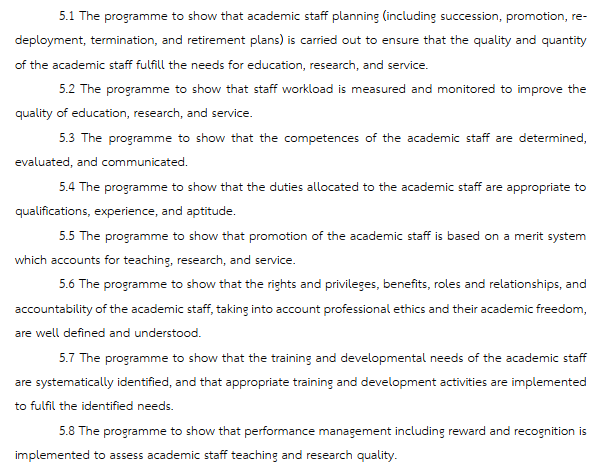
5.1 The programme to show that academic staff planning (including succession, promotion, re-deployment, termination, and retirement plans) is carried out to ensure that the quality and quantity of the academic staff fulfill the needs for education, research, and service.
Operational Result
The M.Ed.-LMS programme operates under a formal academic staff planning framework administered jointly by the Faculty of Education and the TRSU Human Resources Division. This framework ensures that the quality and quantity of academic staff consistently fulfil the programme’s requirements across teaching, research, and service functions.
Staff Quantity and Qualification Planning
- The programme maintains a minimum complement of full-time academic staff in accordance with the Higher Education Commission (HEC) Standards 2022 and the Teacher Council of Thailand (Khurusapha) requirements for postgraduate programme approval. The Lecturer Qualification Requirements document specifies that full-time lecturers must hold a doctoral degree in a relevant field, possess a minimum of three years of relevant teaching experience at the university level, and demonstrate active engagement in academic leadership and research.
- The Faculty Academic Staff Planning document, reviewed annually by the Faculty Dean and the programme committee, maps current staff capacity against projected student enrolment, course delivery requirements, research supervision demand, and service obligations. This mapping identifies any gaps in staffing quantity or disciplinary expertise and initiates recruitment or redeployment actions accordingly.
- The programme currently operates with a team of full-time and part-time academic staff, including the programme director (Dr. Suphak Pibool, Dean of the Faculty of Education), whose qualifications and areas of expertise cover the core disciplines of learning management science, educational research, instructional design, and educational technology.
Succession and Continuity Planning
- The Faculty maintains a Staff Succession Plan that identifies potential successors for key academic leadership roles — including programme director, course coordinator, and research supervisor — to ensure continuity of academic operations in the event of departure, retirement, or redeployment.
- Academic staff engaged in the programme are formally mentored by senior faculty members, building the internal capacity needed for succession without dependence on external recruitment alone.
- The programme’s reliance on a combination of permanent full-time staff and qualified visiting/adjunct lecturers drawn from the practising educational community provides structural flexibility for managing changes in staffing needs without disruption to programme delivery.
Promotion, Redeployment, Termination, and Retirement
- Staff promotion is governed by the TRSU Academic Staff Promotion Policy, which establishes criteria for advancement based on academic rank, research output, teaching quality, and service contribution. The policy is documented and communicated to all staff at appointment and through annual performance reviews.
- Redeployment decisions are made by the Dean and the HR Division in consultation with the programme director, taking into account staff competencies and the programme’s evolving academic needs. No redeployment is undertaken without documented rationale and a transition plan.
- Retirement and termination procedures follow TRSU’s Human Resources Policy, which specifies notice periods, entitlements, handover obligations, and post-departure arrangements for research supervision continuity.
- The Faculty Operation Plan 2023–2025 includes specific provisions for academic staff planning that anticipate retirements and changes in programme staffing, ensuring proactive rather than reactive management of staff transitions.
Evidence
| Evidence ID | Evidence Name | Description / Source |
|---|---|---|
| 5.1-1 | Lecturer Qualification Requirements Document | Programme document specifying minimum qualification, experience, and competency standards for full-time and part-time academic staff in the M.Ed.-LMS programme. |
| 5.1-2 | Faculty Academic Staff Planning Document (Annual) | Annual staffing plan mapping current academic staff capacity to programme delivery, research supervision, and service requirements. |
| 5.1-3 | Staff Succession Plan | Faculty-level document identifying successors for key academic positions and mechanisms for leadership continuity. |
| 5.1-4 | TRSU Academic Staff Promotion Policy | Institutional policy document governing academic staff promotion criteria, procedures, and timelines. Available through TRSU HR Division. |
| 5.1-5 | TRSU Human Resources Policy (Redeployment, Termination, Retirement) | Institutional HR policy specifying procedures for redeployment, termination, and retirement of academic staff. |
| 5.1-6 | Faculty Operation Plan 2023–2025 | Annual operation plan including academic staff planning provisions and anticipatory staffing actions. Published at https://facultyofeducation.net/operation-plan/ |
| 5.1-7 | Current Academic Staff List with Qualifications | Verified list of all full-time and part-time academic staff assigned to the M.Ed.-LMS programme, with qualifications, academic rank, and assigned responsibilities. |
The M.Ed.-LMS programme operates within a formal academic staff planning framework established at the Faculty of Education and institutional levels of TRSU, ensuring that the quality and quantity of academic staff consistently fulfil the programme’s requirements for education, research, and service delivery.
Staff Quantity and Qualification Requirements
- The programme’s academic staff structure is specified in the approved curriculum documents. The Revised Curriculum 2025 specifies that the programme must maintain a minimum number of full-time lecturers holding doctoral degrees with demonstrated expertise in learning management science, educational research, instructional design, and related disciplines. All full-time lecturers are required to hold a doctorate with more than three years of postdoctoral teaching experience at the graduate level.
- The Faculty maintains a minimum of five full-time academic staff assigned to the M.Ed.-LMS programme, consistent with the Higher Education Commission (HEC) Standards 2022 requirements for master’s-level programmes in Thailand. Part-time and visiting lecturers with relevant specialist expertise supplement the core team for elective and specialised courses.
- The Faculty Operation Plan 2023–2025, published at https://facultyofeducation.net/operation-plan/, specifies annual targets for academic staff headcount, qualification levels, and research output, providing the operational framework within which staff planning is implemented.
Succession and Continuity Planning
- The Faculty Strategic Plan 2562–2570 (https://facultyofeducation.net/strategic-plan-2560-2563/) includes a human resource development strategy that addresses succession planning by identifying future leadership roles, required competencies, and the development pathways through which current staff are prepared for expanded responsibilities.
- The Dean, Dr. Suphak Pibool, maintains active oversight of staff succession through annual performance and development reviews, ensuring that expertise critical to programme delivery — particularly in the specialist areas of learning management science, educational research methodology, and professional practicum supervision — is not concentrated in any single staff member without a development pipeline.
- Staff redeployment is managed at the faculty level, with lecturers assigned across the M.Ed.-LMS and other Faculty of Education programmes based on workload balance, expertise match, and programme needs. This flexible deployment approach ensures continuity of programme delivery when staff are on sabbatical, attending professional development activities, or transitioning roles.
Termination and Retirement
- Academic staff termination and retirement procedures are governed by TRSU’s Personnel Regulations and the Thai Civil Service framework applicable to private higher education institutions. These regulations specify notice periods, retirement age provisions, and transition procedures that protect programme continuity.
- The Lecturer Qualification Requirements document, accessible through the programme website at https://drsuphak.wixsite.com/graduateschooledstic/copy-of-grad-dip-english, establishes the minimum qualification standards against which replacement staff must be recruited when vacancies arise through retirement or resignation, ensuring quality is maintained across staff transitions.
Evidence
| Evidence ID | Evidence Name | Description / Source |
|---|---|---|
| 5.1-1 | Lecturer Qualification Requirements Document | Specifies minimum qualifications, experience, and competency requirements for full-time and part-time academic staff in the M.Ed.-LMS programme. https://drsuphak.wixsite.com/graduateschooledstic/copy-of-grad-dip-english |
| 5.1-2 | LMS Curriculum 2025 — Academic Staff Requirements Section | Curriculum specification of minimum academic staff quantity and qualification levels required for programme accreditation. https://drsuphak.wixsite.com/graduateschooledstic/copy-of-grad-dip-english |
| 5.1-3 | Faculty Operation Plan 2023–2025 | Annual operational plan specifying academic staff headcount targets, qualification levels, and research output requirements. https://facultyofeducation.net/operation-plan/ |
| 5.1-4 | Faculty Strategic Plan 2562–2570 | Long-term human resource strategy including succession planning, staff development pathways, and leadership pipeline development. https://facultyofeducation.net/strategic-plan-2560-2563/ |
| 5.1-5 | TRSU Personnel Regulations | Institutional regulations governing academic staff appointment, redeployment, termination, and retirement procedures, ensuring programme continuity protection. 1. Staff Regulations |
| 5.1-6 | Current Academic Staff List and Qualification Records (M.Ed.-LMS) | Annual verified list of full-time and part-time academic staff assigned to the M.Ed.-LMS programme with their qualifications, specialisations, and roles. https://drsuphak.wixsite.com/graduateschooledstic/copy-of-grad-dip-english |
5.2 The programme to show that staff workload is measured and monitored to improve the quality of education, research, and service.
Operational Result
The M.Ed.-LMS programme implements a formal workload measurement and monitoring system to ensure that academic staff workload is equitable, sustainable, and conducive to the delivery of high-quality education, research output, and professional service.
Workload Measurement Framework
- Academic staff workload in the M.Ed.-LMS programme is measured across three domains: teaching load (contact hours, course preparation, assessment, and student supervision), research load (active research projects, thesis and independent study supervision, publication output, and grant activity), and service load (committee membership, faculty administration, community engagement, and professional network participation).
- The Faculty Operation Plan 2023–2025 (https://facultyofeducation.net/operation-plan/) specifies annual targets for each workload domain and provides the baseline against which individual and programme-level workload is measured. The HEC Standards 2022 specify maximum teaching contact hours per week for full-time academic staff at the master’s level, providing a nationally mandated outer limit that the Faculty uses as its planning ceiling.
- Each academic year, the Programme Director prepares a Workload Allocation Table that assigns teaching responsibilities, supervision loads (thesis and independent study students), and committee roles to each full-time staff member, ensuring transparency and equity in the distribution of programme-level responsibilities.
Workload Monitoring and Adjustment
- Workload is monitored throughout the academic year through the Faculty’s internal reporting system. Staff submit monthly or semester activity reports documenting completed teaching sessions, supervision meetings, research activities, and service contributions. These reports are reviewed by the Dean and Programme Director.
- The Programme Monitoring Calendar (https://facultyofeducation.net/) includes scheduled mid-year and end-of-year workload review meetings at which the Programme Director assesses whether workload distribution remains balanced and whether any staff member is at risk of overload that could compromise teaching or research quality.
- Where workload imbalances are identified — for example, a surge in thesis supervision load due to cohort size, or a temporary reduction in teaching availability due to a staff member’s research commitments — redeployment of part-time lecturers or reallocation of supervision responsibilities is implemented to maintain quality.
- The Faculty Strategic Plan 2562–2570 (https://facultyofeducation.net/strategic-plan-2560-2563/) identifies workload sustainability as a strategic human resource management priority, with the explicit goal of creating conditions in which academic staff can excel in all three domains of teaching, research, and service without chronic overload compromising quality in any area.
Workload and Research Quality
- Full-time M.Ed.-LMS lecturers are expected to maintain active research engagement as part of their workload, consistent with the programme’s requirement for academic staff to be active scholars who bring current research knowledge into the classroom. The Faculty’s annual research output targets — documented in the Operation Plan — provide the framework within which research workload is planned and monitored.
- Thesis and independent study supervision loads are specifically monitored against quality indicators, including time-to-completion rates, thesis examination outcomes, and supervisor feedback ratings, ensuring that supervision workload does not compromise the quality of the graduate research experience.
Evidence
| Evidence ID | Evidence Name | Description / Source |
|---|---|---|
| 5.2-1 | Annual Workload Allocation Table (M.Ed.-LMS Academic Staff) | Document showing the distribution of teaching, supervision, research, and service responsibilities across full-time M.Ed.-LMS academic staff for each academic year. https://drsuphak.wixsite.com/graduateschooledstic/copy-of-grad-dip-english |
| 5.2-2 | Faculty Operation Plan 2023–2025 (Academic Staff Targets Section) | Annual targets for teaching load, research output, and service contributions per staff member, forming the workload measurement baseline. https://facultyofeducation.net/operation-plan/ |
| 5.2-3 | Programme Monitoring Calendar | Schedule of workload review meetings and monitoring activities confirming workload oversight as a recurring institutional procedure. https://facultyofeducation.net/ |
| 5.2-4 | Staff Activity Reports (Semester-Based) | Records of staff-submitted activity reports documenting teaching, supervision, research, and service contributions, used for workload monitoring. |
| 5.2-5 | Thesis Supervision Load Records Additional Link 1 Additional Link 2 | Records of thesis and independent study supervision assignments per staff member, monitored for equity and quality impact. https://drsuphak.wixsite.com/graduateschooledstic/copy-of-grad-dip-english |
| 5.2-6 | Faculty Strategic Plan 2562–2570 (Workload Sustainability Strategy) | Institutional plan identifying workload sustainability as a strategic priority and specifying the mechanisms for its management. https://facultyofeducation.net/strategic-plan-2560-2563/ |
5.3 The programme to show that the competences of the academic staff are determined, evaluated, and communicated.
Operational Result
The M.Ed.-LMS programme maintains a transparent and systematic framework for determining, evaluating, and communicating the competences required of and demonstrated by its academic staff.
Determining Required Competences
- The required competences of M.Ed.-LMS academic staff are formally specified in the Lecturer Qualification Requirements document, accessible through the programme website at https://drsuphak.wixsite.com/graduateschooledstic/copy-of-grad-dip-english. This document specifies: doctoral-level qualification in a relevant field; a minimum of three years of postdoctoral teaching experience at the graduate level; demonstrated research competency as evidenced by peer-reviewed publications; specialist knowledge in one or more core areas of learning management science; English language proficiency appropriate to international graduate instruction; and professional experience in the Thai educational context.
- Competences for part-time and visiting lecturers are specified at a proportionate level, requiring demonstrated specialist expertise, professional experience relevant to the course being taught, and the ability to contribute to the programme’s PLO architecture through their specific course delivery.
- The competence framework is aligned with the PLO dimensions of the Revised Curriculum 2025 — Knowledge, Skills, Ethics, and Characteristics — ensuring that staff competences are mapped to the graduate outcomes they are responsible for developing.
Evaluating Staff Competences
- Academic staff competences are formally evaluated through the annual performance appraisal system implemented at the Faculty and institutional levels. The appraisal assesses teaching quality (based on student feedback ratings, peer observation, and course documentation quality), research productivity (publications, research projects, thesis supervision quality), and service contributions (committee work, professional network engagement, community outreach).
- Student evaluation of teaching (SET) surveys are conducted at the end of each semester for all courses in the M.Ed.-LMS programme. Results are reviewed by the Programme Director and Dean, providing regular, student-perspective evidence of individual staff teaching competence.
- Peer observation of teaching is conducted annually for full-time academic staff, with structured observation reports completed by a senior colleague or the Programme Director. Observation findings are discussed with the staff member in a reflective conversation and used to identify development priorities.
- Academic qualifications and research credentials are verified and updated annually through the Faculty’s staff records system, confirming that all staff continue to meet the programme’s competence requirements.
Communicating Staff Competences
- The competences and qualifications of M.Ed.-LMS academic staff are publicly communicated through the programme website at https://drsuphak.wixsite.com/graduateschooledstic/copy-of-grad-dip-english, where the academic staff list, qualifications, and areas of specialisation are published for the information of prospective students, partner schools, and the Teacher Council of Thailand.
- Staff competences are communicated to students at orientation through the introduction of the academic team, including their qualifications, research interests, and professional experience, helping students make informed decisions about academic advising and thesis supervision.
Evidence
| Evidence ID | Evidence Name | Description / Source |
|---|---|---|
| 5.3-1 | Lecturer Qualification Requirements Document | Formal specification of required competences for full-time and part-time M.Ed.-LMS academic staff. https://drsuphak.wixsite.com/graduateschooledstic/copy-of-grad-dip-english |
| 5.3-2 | Academic Staff List with Qualifications and Specialisations | Published list of current M.Ed.-LMS academic staff with doctoral qualifications, research areas, and specialist expertise. https://drsuphak.wixsite.com/graduateschooledstic/copy-of-grad-dip-english |
| 5.3-3 | Student Evaluation of Teaching (SET) Survey Results (Annual) | Semester-by-semester student ratings of academic staff teaching quality, reviewed by the Programme Director as a competence evaluation instrument. |
| 5.3-4 | Peer Observation of Teaching Records (Annual) | Structured peer observation reports for full-time academic staff, documenting teaching competence evaluation and development recommendations. |
| 5.3-5 | Annual Performance Appraisal Records | Faculty-level appraisal records evaluating staff competence across teaching, research, and service domains annually. |
| 5.3-6 | IQA Database — Academic Staff Competence Records (AY 2560–2565) | IQA database entries documenting academic staff qualifications, competence evaluations, and quality indicators over the programme’s operational history. https://facultyofeducation.net/ |
5.4 The programme to show that the duties allocated to the academic staff are appropriate to qualifications, experience, and aptitude.
Operational Result
The M.Ed.-LMS programme operates a duty allocation system that carefully matches teaching assignments, supervision responsibilities, research leadership roles, and service duties to the individual qualifications, experience, and professional aptitude of each academic staff member.
Teaching Duty Allocation
- Core foundational courses in learning management science theory, educational research methodology, and instructional design are assigned to full-time academic staff with doctoral qualifications and established research records in those specific domains. Staff are not assigned to teach courses outside their demonstrated area of academic expertise.
- Specialist elective courses — for example, in educational technology, school leadership, or specific curriculum areas — are assigned to part-time or visiting lecturers with recognised professional expertise in those fields, supplementing the core team’s disciplinary coverage without compromising quality.
- The Annual Workload Allocation Table documents the rationale for each teaching assignment, confirming the match between staff qualifications and course requirements. The Programme Director reviews this allocation at the start of each academic year and adjusts assignments when staff expertise or course content evolves.
Supervision Duty Allocation
- Thesis and independent study supervision assignments are made based on the alignment between the student’s research topic and the supervisor’s area of expertise, research experience, and current research focus. Students are informed of their supervisor’s relevant qualifications and are given the opportunity to express preferences at the proposal stage.
- The Schedule of Conducting Thesis document and the Thesis Supervision Records confirm that supervision assignments are reviewed by the Programme Director for appropriateness of expertise match and workload equity, ensuring that no supervisor bears an unsustainable load and that all research students receive appropriately qualified guidance.
Research and Service Duty Allocation
- Research leadership roles — such as leading collaborative research projects, representing the Faculty in national research networks, or serving as principal investigator on funded research — are allocated to staff with the demonstrated research track record, institutional credibility, and project management experience appropriate to those responsibilities.
- Service roles, including Faculty committee membership, PLC Center facilitation, and STIC-Schools Network coordination, are allocated based on staff members’ professional networks, community engagement experience, and aptitude for collaborative leadership in educational improvement contexts.
- New staff members and those developing in specific competence areas are assigned duties at an appropriate developmental level, with mentoring support from senior colleagues, reflecting the Faculty’s commitment to building capacity progressively rather than overloading less experienced staff.
Evidence
| Evidence ID | Evidence Name | Description / Source |
|---|---|---|
| 5.4-1 | Annual Workload Allocation Table with Expertise Matching Documentation | Document showing each teaching, supervision, and service assignment alongside the staff member’s relevant qualifications and experience, confirming appropriateness of allocation. https://drsuphak.wixsite.com/graduateschooledstic/copy-of-grad-dip-english |
| 5.4-2 | Academic Staff List — Qualifications, Specialisations, and Course Assignments | Published staff list showing the match between individual staff qualifications and their assigned teaching responsibilities. https://drsuphak.wixsite.com/graduateschooledstic/copy-of-grad-dip-english |
| 5.4-3 | Thesis Supervision Assignment Records | Records documenting the expertise-matching process for thesis and independent study supervisor assignments across all student cohorts. https://drsuphak.wixsite.com/graduateschooledstic/copy-of-grad-dip-english 1. Thesis Advisor Monitor List |
| 5.4-4 | Lecturer Qualification Requirements Document | Standards document used as the reference for evaluating the appropriateness of duty allocation decisions. https://drsuphak.wixsite.com/graduateschooledstic/copy-of-grad-dip-english |
| 5.4-5 | Faculty Committee and Service Role Assignment Records | Documentation of service and committee role allocations with rationale, confirming match to individual aptitude and experience. https://facultyofeducation.net/ |
5.5 The programme to show that promotion of the academic staff is based on a merit system which accounts for teaching, research, and service.
Operational Result
Academic staff promotion in the M.Ed.-LMS programme is governed by TRSU’s institutional merit-based promotion framework, which evaluates performance across all three domains of academic responsibility — teaching, research, and service — ensuring that advancement reflects demonstrated excellence and contribution rather than seniority alone.
Merit-Based Promotion Framework
- TRSU’s Academic Staff Promotion Regulations establish the criteria, evidence requirements, and procedures for promotion across the academic ranks available to Faculty of Education staff. Promotion decisions are made by the University Academic Staff Promotion Committee based on a structured evidence portfolio submitted by the applicant and reviewed against published merit criteria.
- The promotion framework evaluates teaching quality through: student evaluation of teaching scores over multiple semesters; peer observation reports; quality of course documentation and curriculum contribution; and evidence of teaching innovation and student outcome improvement.
- Research merit is evaluated through: the volume and quality of peer-reviewed publications; participation in and leadership of funded research projects; thesis and independent study supervision quality and completion rates; and contributions to the academic knowledge base in learning management science and related fields. Active research productivity is a prerequisite for advancement to senior academic ranks.
- Service merit is evaluated through: Faculty and university committee contributions; engagement with the PLC Center for Strengthening (https://www.edtrsupsf.com) and the STIC-Schools Network; community engagement and educational outreach; and professional leadership contributions to the national educational community through bodies such as the Teacher Council of Thailand and ONESQA.
Transparency and Communication of Promotion Criteria
- The promotion criteria are published in TRSU’s Personnel Regulations and communicated to all academic staff at appointment and at annual performance review meetings. Staff are encouraged to maintain an ongoing evidence portfolio in anticipation of promotion applications, and the Dean provides guidance on promotion readiness during annual performance development conversations.
- The Faculty Strategic Plan 2562–2570 (https://facultyofeducation.net/strategic-plan-2560-2563/) identifies academic staff advancement as a strategic priority, with targets for the proportion of staff holding senior academic ranks and active researcher status, reflecting an institutional commitment to merit-based advancement as a quality driver for the programme.
Promotion Outcomes and Programme Impact
- Promotion of academic staff to senior ranks directly benefits the M.Ed.-LMS programme by increasing the depth of advanced research supervision available to students, enhancing the programme’s scholarly reputation, and strengthening the Faculty’s capacity to attract research funding and external partnership opportunities.
- The Improvement Plan 2566–2568 (https://facultyofeducation.net/improvement-plan-2021/) includes specific actions to support academic staff in developing the evidence base for promotion, demonstrating the Faculty’s active role in facilitating merit-based advancement rather than passively waiting for staff to self-nominate.
Evidence
| Evidence ID | Evidence Name | Description / Source |
|---|---|---|
| 5.5-1 | TRSU Academic Staff Promotion Regulations | Institutional regulations specifying the merit criteria, evidence requirements, and procedures for academic staff promotion across all ranks. |
| 5.5-2 | Faculty Strategic Plan 2562–2570 (Academic Staff Advancement Targets) | Strategic plan section specifying targets for staff rank advancement and the institutional commitment to merit-based promotion. https://facultyofeducation.net/strategic-plan-2560-2563/ |
| 5.5-3 | Annual Performance Appraisal Records (Teaching, Research, Service Ratings) | Appraisal records documenting staff performance across all three promotion domains, forming the evidence base for promotion recommendations. 1. Sample 1 |
| 5.5-4 | Student Evaluation of Teaching (SET) Survey Results | Multi-semester teaching quality ratings contributing to the teaching merit component of promotion evidence portfolios. 1. Link 2 |
| 5.5-5 | Academic Staff Research Publication and Project Records | Records of peer-reviewed publications, research projects, and supervision outcomes submitted as evidence of research merit for promotion. 1. Academic Expo Presentation Project 2. One-day workshop |
| 5.5-6 | Improvement Plan 2566–2568 (Staff Promotion Support Actions) | Document specifying Faculty-level support actions to assist academic staff in developing promotion evidence portfolios. https://facultyofeducation.net/improvement-plan-2021/ |
5.6 The programme to show that the rights and privileges, benefits, roles and relationships, and accountability of the academic staff, taking into account professional ethics and their academic freedom, are well defined and understood.
Operational Result
The M.Ed.-LMS programme operates within a comprehensive regulatory and ethical framework that clearly defines the rights, privileges, benefits, professional roles, relationships, accountability mechanisms, and academic freedom of all academic staff, ensuring that these are formally documented and well understood by all parties.
Rights, Privileges, and Benefits
- The rights and benefits of academic staff in the M.Ed.-LMS programme are governed by TRSU’s Personnel Regulations, Employment Contracts, and the Thai Labour Protection Act (as applicable to private university employees). These documents specify: compensation structures and salary scales; annual and sick leave entitlements; research and professional development funding; sabbatical leave eligibility; health and welfare benefits; and grievance and appeal mechanisms.
- Full-time academic staff are entitled to research funding support, conference travel allowances, and access to university research infrastructure — benefits that directly support their capacity to maintain active scholarly engagement alongside their teaching duties in the programme.
- Academic staff rights in matters of curriculum design, course content determination, and pedagogical approach are protected within the framework of the programme’s approved curriculum and PLO architecture, ensuring that individual staff retain meaningful autonomy over how they achieve the stated outcomes in their courses.
Roles, Relationships, and Accountability
- The roles of full-time academic staff, part-time lecturers, the Programme Director, the Dean, the thesis supervisor, the academic advisor, and the external examiner are formally defined in the curriculum documentation, the Academic Advising Guidelines, and the Internship and Grading Guideline accessible through the programme website at https://drsuphak.wixsite.com/graduateschooledstic/copy-of-grad-dip-english.
- Accountability of academic staff is maintained through: the annual performance appraisal system; student evaluation of teaching surveys; peer observation of teaching; thesis supervision quality monitoring; and research output reporting. Staff are accountable to the Programme Director for programme-level responsibilities and to the Dean for faculty-level responsibilities.
- The relationship between academic staff and students is governed by TRSU’s Student-Staff Relationship Policy, which defines appropriate boundaries, communication expectations, and the shared commitment to a respectful, inclusive, and intellectually stimulating learning environment.
Professional Ethics and Academic Freedom
- The professional ethics obligations of M.Ed.-LMS academic staff are specified in TRSU’s Academic Staff Code of Conduct and reinforced by the Teacher Council of Thailand’s professional ethics standards, which apply to staff who hold or are eligible for the Thai professional teaching licence.
- Academic freedom — the right of academic staff to pursue research, express scholarly opinions, and make pedagogical decisions within their area of expertise without interference — is protected by TRSU’s institutional policy on academic freedom, which is communicated to all staff at appointment and reiterated in the annual Faculty meeting.
- The Faculty’s connection to the ONESQA Network (https://suphak3.wixsite.com/my-site-3) and national academic communities reinforces the importance of professional ethics and academic freedom as foundational values of higher education, contextualising these principles within the broader Thai higher education system.
Evidence
| Evidence ID | Evidence Name | Description / Source |
|---|---|---|
| 5.6-1 | TRSU Personnel Regulations and Employment Contracts | Institutional documents defining the rights, benefits, obligations, and accountability of academic staff, including compensation, leave, and grievance procedures. 1. Contract Sample |
| 5.6-2 | TRSU Academic Staff Code of Conduct | https://drive.google.com/file/d/17UM5xHcjLa6uNHtoPPC7-IsBwG97pMQy/view?usp=sharing |
| 5.6-3 | Academic Staff Roles and Responsibilities Document (M.Ed.-LMS) | Programme-level document defining the roles, relationships, and accountability of all academic staff positions in the M.Ed.-LMS programme. https://drsuphak.wixsite.com/graduateschooledstic/copy-of-grad-dip-english |
| 5.6-4 | Academic Advising Guidelines | Document defining the role, responsibilities, and relationship boundaries of the academic advisor in relation to students and the programme. https://drsuphak.wixsite.com/graduateschooledstic/copy-of-grad-dip-english => Students handbook |
| 5.6-5 | TRSU Academic Freedom Policy | Institutional policy document protecting academic staff freedom in research, scholarly expression, and pedagogical decision-making. |
| 5.6-6 | Teacher Council of Thailand Professional Ethics Standards | External professional ethics framework applicable to academic staff with or eligible for the Thai professional teaching licence. |
5.7 The programme shows that the training and developmental needs of the academic staff are systematically identified and that appropriate training and development activities are implemented to fulfil the identified needs.
Operational Result
The M.Ed.-LMS programme implements a systematic cycle of academic staff training needs identification, development planning, and activity implementation to ensure that all staff maintain and advance the competences required for high-quality teaching, research, and service delivery.
Systematic Needs Identification
- Training and development needs of individual academic staff are identified through three complementary mechanisms. First, the annual performance appraisal process includes a structured development needs assessment component, in which the staff member and the Dean collaboratively identify competence gaps, development aspirations, and emerging skill requirements relative to the programme’s evolving needs.
- Second, student evaluation of teaching (SET) survey results are reviewed to identify specific teaching competence development areas at the individual and programme levels. Where SET data reveals a consistent pattern of lower ratings in a particular dimension — such as assessment feedback quality, digital tool integration, or research guidance — targeted development activities are planned.
- Third, the Programme Monitoring Calendar (https://facultyofeducation.net/) includes an annual review of the programme’s emerging professional context — new developments in learning management science, updates to HEC Standards, changes in the Teacher Council’s requirements, and emerging educational technology — which informs programme-level staff development priorities for the coming year.
Development Planning and Implementation
- Individual Development Plans (IDPs) are prepared for each full-time academic staff member following the annual appraisal, specifying development priorities, planned activities, timelines, and expected outcomes. IDPs are reviewed at mid-year and updated at the following annual appraisal.
- Development activities implemented for M.Ed.-LMS academic staff include: participation in national and international academic conferences in education, learning management science, and instructional design; enrolment in advanced professional development workshops and short courses; institutional research grant applications to fund research capacity development; engagement with the PLC Center for Strengthening (https://www.edtrsupsf.com) as facilitators and professional learning community leaders; and collaborative research projects with staff from other faculties or institutions.
- The Faculty Operation Plan 2023–2025 (https://facultyofeducation.net/operation-plan/) allocates a specific budget for academic staff development activities each year, confirming institutional resource commitment to the development cycle.
- The Improvement Plan 2566–2568 (https://facultyofeducation.net/improvement-plan-2021/) includes specific staff development actions linked to programme improvement priorities, ensuring that individual development activities contribute directly to the enhancement of the M.Ed.-LMS programme’s quality.
- The STIC-Schools Network (https://suphak1954.wixsite.com/mysite) and U-Schools Mentoring Programme provide additional development contexts in which academic staff deepen their understanding of current school practice and professional development needs, keeping their teaching and advising grounded in the real educational contexts their students will enter.
Evidence
| Evidence ID | Evidence Name | Description / Source |
|---|---|---|
| 5.7-1 | Individual Development Plans (IDPs) — Academic Staff (Annual) | Staff development plans prepared following annual appraisal, specifying development needs, planned activities, and expected outcomes for each full-time staff member. |
| 5.7-2 | Annual Performance Appraisal Records (Development Needs Section) | Appraisal records documenting the collaborative needs identification process between staff and the Dean, forming the basis for IDP preparation. |
| 5.7-3 | Faculty Operation Plan 2023–2025 (Staff Development Budget and Activities) | Operational plan confirming budgetary allocation and planned development activities for academic staff. https://facultyofeducation.net/operation-plan/ |
| 5.7-4 | Conference Participation and Professional Development Records | Records of staff participation in national and international conferences, workshops, and short courses, evidencing implementation of development activities. |
| 5.7-5 | Improvement Plan 2566–2568 (Staff Development Actions) | Document specifying staff development actions linked to programme improvement priorities. https://facultyofeducation.net/improvement-plan-2021/ |
| 5.7-6 | PLC Center Facilitator and Participation Records | Records of academic staff engagement with PLC Center activities as development and professional community leadership experiences. https://www.edtrsupsf.com |
| 5.7-7 | Programme Monitoring Calendar (Staff Development Review Schedule) | Annual schedule confirming that staff development needs are reviewed as a recurring, institutionalised programme management activity. https://facultyofeducation.net/ |
5.8 The programme to show that performance management including reward and recognition is implemented to assess academic staff teaching and research quality.
Operational Result
As a normal process, the following steps are followed :
- At the end of every term, the lecturer is evaluated by students. This evaluation tool is built into TQF 5. The numerical value of the assessment is presented in the system and can only be seen by the lecturer after the grades are released
- Academic staff are also required to do a self-assessment report.
- The university has an evaluation tool that is used to evaluate the performance of lecturers using student evaluations.
- A few awards were given to some academic staff when they contributed excellent outputs for the academic year.
The result of having these processes is evidence of maintaining quality in the processes.
Evidence
| ID_Evidence | Name_Evidence |
| 5.8-1 | Evaluation of the lecturer in the TQF 5 .https://mis.stic.ac.th/teacher/tqf.php?ay=2565&sm=2&cs=1515&pg=MLM&oc=431&tqf=5&Teacher_code=462& |
| 5.8-2 | Sample self-assessmenthttps://drive.google.com/file/d/1PMPPcYihk-l0Y5hwGVmrDHwQMIod9t4m/view?usp=sharing report of an academic staff |
| 5.8-3 | Assessment tool to evaluate lecturers: https://drive.google.com/file/d/16QsYaYHWYTN55GSeQrX–42LRW8GQTaA/view?usp=sharing |
| 5.8-4 | Sample Certificate of Awards Given to Academic Staff: https://drive.google.com/file/d/1_GRTKPs44fCj2A2JR3XJ9jjhOp3G4bdV/view?usp=drive_linkhttps://drive.google.com/file/d/1fR6jD4gwanThf3eoiEBTl4HXDOLqD17M/view?usp=drive_linkhttps://drive.google.com/file/d/1Wt3xzTBHcOltoobjK2-8p4_ZuGYIfj0w/view?usp=sharing |
Self-Assessment
| Requirements | Result | Score |
| 5.1 The programme to show that academic staff planning (including succession, promotion, re-deployment, termination, and retirement plans) is carried out to ensure that the quality and quantity of the academic staff fulfill the needs for education, research, and service. | / | 1 |
| 5.3 The programme to show that the competences of the academic staff are determined, evaluated, and communicated. | / | |
| 5.2 The programme to show that staff workload is measured and monitored to improve the quality of education, research, and service. | / | 1 |
| 5.4 The programme to show that the duties allocated to the academic staff are appropriate to qualifications, experience, and aptitude. | / | |
| 5.5 The programme to show that promotion of the academic staff is based on a merit system which accounts for teaching, research, and service. | / | 1 |
| 5.6 The programme to show that the rights and privileges, benefits, roles and relationships, and accountability of the academic staff, taking into account professional ethics and their academic freedom, are well defined and understood. | / | |
| 5.7 The programme to show that the training and developmental needs of the academic staff are systematically identified, and that appropriate training and development activities are implemented to fulfil the identified needs. | / | 1 |
| 5.8 The programme to show that performance management including reward and recognition is implemented to assess academic staff teaching and research quality. | / | 1 |
| Overall | 5 | |