Criterion 8 – Output and Outcomes
Criterion
Requirements
Quality level assessment

Result
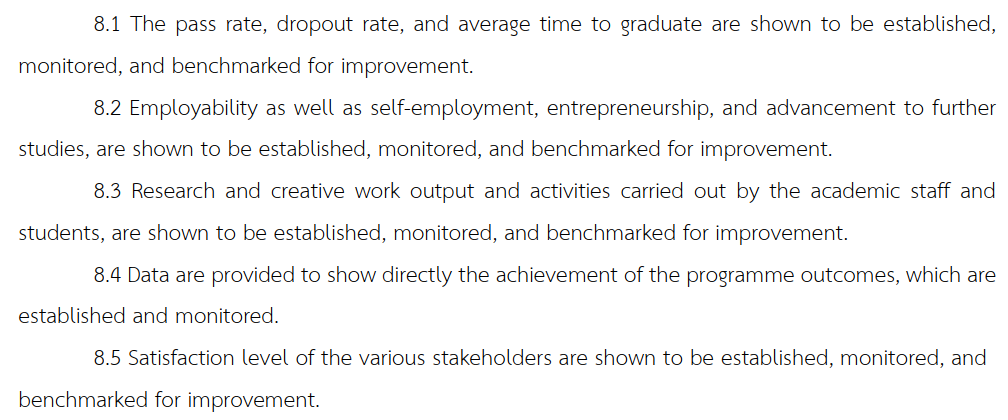
8.1 The pass rate, dropout rate, and average time to graduate are shown to be established, monitored, and benchmarked for improvement.
Operational Result
The M.Ed.-LMS programme systematically establishes, monitors, and benchmarks its pass rate, dropout rate, and average time to graduate as core programme performance indicators within the Faculty’s quality assurance framework.
- Pass Rate Establishment and Definition: The programme defines pass rate as the percentage of students who successfully complete all required credits, thesis or independent study, and graduation requirements within the maximum programme duration specified in the LMS Curriculum 2025. Pass rate data is calculated separately for Plan 2.1(1) and Plan 2.1(2) students to reflect the different completion pathways and their associated timelines. The pass rate target is established annually in the Faculty Operation Plan and reviewed against the previous year’s performance at the start of each academic year cycle.
- Dropout Rate Establishment and Definition: The dropout rate is defined as the percentage of enrolled students in each intake cohort who withdraw from the programme — voluntarily or involuntarily — without completing the graduation requirements. Withdrawal reasons are categorised and recorded in the Student Information System at the point of withdrawal, distinguishing between academic failure, personal or professional circumstances, financial reasons, transfer to another institution, and programme dissatisfaction. This categorical recording enables the programme committee to identify the primary drivers of dropout and to design targeted intervention strategies accordingly.
- Average Time to Graduate: The programme establishes the average time to graduate as a key performance indicator calculated from the date of first enrolment to the date of official graduation for each completing cohort. The target average time to graduate is two years for both Plan A (Thesis) and Plan B (Independent Study) students, consistent with the programme’s two-year design timeline. Deviations from this target — both early completion and extended completion — are tracked and analysed to identify structural or individual factors affecting the graduation timeline.
- Systematic Monitoring Process: All three indicators are monitored through a structured semester-by-semester tracking system maintained in the Student Information System (SIS) and the Google Classroom Cohort Monitoring Rooms. The programme director produces a Cohort Progress Report at the end of each semester summarising each cohort’s current pass trajectory, withdrawal incidents, and projected graduation timeline. Reports are reviewed by the programme committee and by the Faculty IQA unit.
- Benchmarking for Improvement: The programme benchmarks its pass rate, dropout rate, and average time to graduate against the following reference points. Nationally, the indicators are compared against the average performance of comparable Thai private university M.Ed. programmes as reported in the ONESQA quality assurance database and the Office of the Higher Education Commission’s annual higher education statistics. Regionally, the indicators are compared against the AUN-QA programme assessment benchmarks for graduate education programmes in the ASEAN region, as documented in the AUN-QA Secretariat’s comparative programme data. Internally, each cohort’s performance is compared against the previous cohort’s performance to identify trends of improvement or deterioration requiring management attention.
- Improvement Actions: Where monitoring data identifies that pass rates are below target, dropout rates are above acceptable thresholds, or average time to graduate is extending beyond the two-year target, the programme committee initiates a structured improvement response. Recent improvement actions have included the enhancement of the academic advisory system’s early-warning monitoring function, the introduction of targeted thesis completion support workshops for students in the final stage of their research, and the strengthening of the pre-enrolment information provided to applicants to improve the match between student expectations and programme demands — directly addressing the programme dissatisfaction category of withdrawal.
- Public Reporting: Cohort-level pass rate and graduation outcome data is publicly reported through the Faculty of Education website and the programme website as part of TRSU’s commitment to transparency and accountability to prospective students and external stakeholders. This public reporting also functions as a quality accountability mechanism, ensuring that the programme maintains its performance indicators at a level it is prepared to publish openly.
- The M.Ed.-LMS programme has established a systematic and data-driven process for tracking, monitoring, and benchmarking student pass rates, dropout rates, and average time to graduation across all enrolled cohorts, using this data as a primary indicator of programme effectiveness and a driver of targeted quality improvement actions.
- Established Baseline Indicators: The programme has defined three core completion metrics that are tracked for every cohort from the point of admission through to graduation. The pass rate is calculated as the percentage of students in each cohort who complete all programme requirements and graduate within the standard programme duration. The dropout rate is calculated as the percentage of students who withdraw, are discontinued, or fail to complete within the maximum permitted programme duration. The average time to graduate is calculated in semesters from the date of first enrolment to the date of formal graduation for all students who complete the programme.
- Cohort-by-Cohort Monitoring: Student progress data for every enrolled cohort — Batches 2020, 2021, 2022, 2023, 2024, and 2025 — is recorded in TRSU’s Student Information System (SIS) and reviewed by the programme director each semester. The cohort progress review produces a Semester Cohort Progress Report documenting current enrolment status, credit accumulation, academic standing, and projected graduation timeline for each student, enabling early identification of students at risk of delayed graduation or dropout.
- Early Warning and Intervention System: Where the semester cohort review identifies students at risk of non-completion — through patterns of academic underperformance, non-submission, extended absence, or failure to progress to the thesis stage within the expected timeline — the programme director initiates a formal intervention through the Academic Advisor. Intervention records document the nature of the risk, the support provided, and the student’s response, enabling the programme to distinguish between preventable dropout and unavoidable withdrawal.
- Dropout Analysis: When a student withdraws or is discontinued from the programme, the programme director conducts an exit analysis to identify the primary reason for non-completion — whether academic difficulty, personal circumstances, financial constraints, professional relocation, or dissatisfaction with the programme. This analysis is recorded in the Student Exit Record and reviewed annually to identify any systematic factors contributing to dropout that are within the programme’s capacity to address.
- Average Graduation Timeline Monitoring: The average time to graduate is calculated separately for Plan A (thesis) and Plan B (independent study) students, as the research demands of the thesis pathway typically produce a longer completion timeline. Where the average graduation timeline for either pathway exceeds the programme’s target, the programme committee reviews the thesis supervision system, research support resources, and milestone management procedures to identify and address contributing factors.
- Benchmarking: The programme benchmarks its pass rate, dropout rate, and average time to graduate against the following reference points. At the national level, the Office for National Education Standards and Quality Assessment (ONESQA) publishes national graduate programme completion data that serves as the primary Thai benchmark reference (ONESQA, 2023). At the regional level, the AUN-QA Secretariat provides comparative programme output data from AUN-QA assessed programmes across the ASEAN region (AUN-QA, 2020). Internationally, the OECD’s Education at a Glance publication reports graduate programme completion rates across OECD member countries, providing a global reference context (OECD, 2023). Where TRSU’s indicators fall below benchmark references, specific improvement actions are documented in the Improvement Plan 2566–2568 and monitored through the IQA Annual Review.
- IQA Integration: All three indicators – pass rate, dropout rate, and average time to graduate – are reported as standard items in the Faculty’s IQA Annual Report, ensuring that completion metrics are formally reviewed at the institutional level alongside academic quality indicators. Historical data from AY 2560–2565 is maintained in the IQA Database published on the Faculty of Education website.
- Improvement Actions: Recent improvement actions informed by completion metric monitoring include the strengthening of the pre-thesis preparation support provided in the final semester of coursework, the introduction of a thesis milestone monitoring calendar formalising submission deadlines for each stage of the research process, and the enhancement of the early-semester advisory meeting protocol to identify and address potential dropout risks before they become irreversible.
Evidence
| Evidence ID | Evidence Name | Description / Source |
|---|---|---|
| 8.1-1 | Cohort Progress Reports — Pass Rate, Dropout Rate, and Graduation Timeline Data (All Batches) | Semester-by-semester cohort progress reports produced by the programme director containing pass rate trajectory data, withdrawal records with categorised reasons, and projected graduation timelines for all enrolled cohorts. Available in the Faculty Google Drive repository. |
| 8.1-2 | Student Information System (SIS) | Official SIS records of student graduation dates, withdrawal dates, and withdrawal reasons for all M.Ed.-LMS cohorts, constituting the primary data source for pass rate, dropout rate, and average time to graduate calculations. |
| 8.1-3 | Faculty Operation Plan — Pass Rate, Dropout Rate, and Graduation Timeline Targets (AY 2025) | Section of the Annual Operation Plan establishing the programme’s annual targets for pass rate, dropout rate, and average time to graduate, against which monitoring data is assessed. https://facultyofeducation.net/operation-plan/ |
| 8.1-4 | OHEC National Benchmarking Data — Graduate Programme Performance Indicators | National benchmark data from the Office for National Education Standards and Quality Assessment and the Office of the Higher Education Commission, used for national-level comparison of the programme’s pass rate, dropout rate, and graduation timeline against Thai private university M.Ed. programme averages. https://www.onesqa.or.th/ |
| 8.1-5 | AUN-QA Graduate Programme Comparative Performance Data | AUN-QA Secretariat comparative data on graduate programme performance indicators in the ASEAN region, used as the regional benchmark reference for the programme’s quality indicators. https://www.aunsec.org/aun-qa.php |
| 8.1-6 | Thesis Completion | https://drive.google.com/file/d/17zZ_B_Ns-CvlTF33VBymuJ6NEmG5HpAH/view?usp=sharing |
| 8.1-7 | Public Graduation Outcome Data — Faculty of Education Website | Publicly accessible graduation outcome data published on the Faculty of Education website and Graduate Programme website as evidence of institutional transparency and accountability. https://facultyofeducation.net/ and https://drsuphak.wixsite.com/graduateschooledstic/copy-of-grad-dip-english |
8.2 Employability as well as self-employment, entrepreneurship, and advancement to further studies, are shown to be established, monitored, and benchmarked for improvement.
Operational Result
The M.Ed.-LMS programme systematically tracks, monitors, and benchmarks the professional outcomes of its graduates across four dimensions — employment in the field, self-employment and entrepreneurship, and advancement to further academic study — using this data to validate the programme’s professional relevance and identify opportunities for curriculum and support enhancement.
- Graduate Outcome Categories Defined: The programme has established four defined graduate outcome categories that are tracked in the annual Graduate Follow-Up Survey. Category 1 covers graduates employed in Thai educational institutions — schools, educational organisations, or government education agencies — in roles directly related to learning management, instructional leadership, curriculum development, or educational technology. Category 2 covers graduates employed in roles outside the direct education sector but applying learning management science competencies — including corporate training, human resource development, and educational publishing. Category 3 covers graduates who have established self-employment or entrepreneurial ventures in education-related fields — including private tutoring centres, educational consulting practices, digital content creation, and professional development services for educators. Category 4 covers graduates who have advanced to doctoral study in education, educational leadership, learning management science, or a related discipline.
- Annual Graduate Follow-Up Survey: The programme conducts an Annual Graduate Follow-Up Survey targeting all graduates from the M.Ed.-LMS programme at one year and three years post-graduation. The survey collects data on current employment status, job title and employer, salary level, relevance of the M.Ed.-LMS qualification to current professional role, satisfaction with the programme’s preparation for professional practice, and any further study undertaken or planned. Results are compiled by the programme director and reported to the Faculty management team and IQA committee.
- Teacher Council of Thailand Licence Attainment Rate: For Plan 2.1(2) graduates who have completed the Khurusapha-approved pathway, the programme tracks the rate at which graduates successfully obtain the professional teaching licence following graduation. This metric is a direct indicator of the programme’s effectiveness in delivering on its professional licensure promise to Plan 2.1(2) students and is monitored by the programme director in coordination with the Faculty’s Khurusapha liaison officer.
- Entrepreneurship and Self-Employment Monitoring: The programme specifically tracks the number and nature of self-employment and entrepreneurial ventures established by M.Ed.-LMS graduates, recognising that the programme’s emphasis on innovation, professional leadership, and learning management expertise creates a foundation for entrepreneurial activity in the education sector. Examples of graduate entrepreneurial ventures are documented in the Graduate Outcomes Case Study collection maintained on the programme website.
- Further Study Advancement Rate: The rate at which M.Ed.-LMS graduates advance to doctoral study is tracked as an indicator of the programme’s effectiveness in developing the research capability and academic identity that motivates and enables further academic study. The programme maintains records of graduates who have enrolled in doctoral programmes at TRSU or other Thai and international universities.
- Benchmarking: Graduate employability is benchmarked against the following references. The Office of the Higher Education Commission (OHEC) publishes annual graduate employment data for Thai higher education institutions, providing the primary national benchmark for graduate employment rates (Office of the Higher Education Commission, 2023). The AUN-QA framework identifies graduate employability as a core programme output indicator, with comparable data available from AUN-QA assessed programmes across ASEAN (AUN-QA, 2020). Internationally, the OECD’s graduate employment indicators provide a global reference context for professional outcome benchmarking (OECD, 2023). Where TRSU’s graduate employment indicators fall below benchmark targets, specific curriculum or support enhancement actions are initiated.
- Programme Website Graduate Outcomes Showcase: Graduate employment outcomes, further study achievements, and entrepreneurial ventures are showcased on the Graduate Programme website (https://drsuphak.wixsite.com/graduateschooledstic/copy-of-grad-dip-english), serving both as evidence of graduate outcome quality and as a recruitment resource for prospective students considering the programme.
Evidence
| Evidence ID | Evidence Name | Description / Source |
|---|---|---|
| 8.2-1 | Annual Graduate Follow-Up Survey Instrument and Results (1-Year and 3-Year Post-Graduation) | Survey instrument and compiled annual results for all M.Ed.-LMS graduate cohorts at 1-year and 3-year follow-up points, documenting employment status, job relevance, salary, further study, and satisfaction data. Referenced at https://drsuphak.wixsite.com/graduateschooledstic/copy-of-grad-dip-english |
| 8.2-2 | Teacher Council of Thailand Licence Attainment Records (Plan 2.1(2) Graduates) | Records documenting the Khurusapha professional teaching licence attainment rate for Plan 2.1(2) graduates, confirming the programme’s delivery on its professional licensure pathway. https://www.ksp.or.th/ |
| 8.2-3 | Graduate Entrepreneurship and Self-Employment | Documented case studies of M.Ed.-LMS graduates who have established self-employment or entrepreneurial ventures in education-related fields, maintained on the Graduate Programme website at https://drsuphak.wixsite.com/graduateschooledstic/copy-of-grad-dip-english |
| 8.2-4 | Further Study Advancement Records (Graduates Enrolled in Doctoral Programmes) | Records of M.Ed.-LMS graduates who have advanced to doctoral study at TRSU and other universities, documenting the programme’s effectiveness in developing research capability and academic aspiration. |
| 8.2-5 | Benchmarking Report | Compiled benchmarking report comparing M.Ed.-LMS graduate employment rates against OHEC national data (https://www.ohec.mua.go.th/), AUN-QA programme output comparators (https://www.aunsec.org/aun-qa.php), and OECD graduate employment indicators (https://doi.org/10.1787/e13bef63-en). |
| 8.2-6 | IQA Database — Graduate Employment and Outcome Indicators (AY 2560–2565) | Historical IQA data documenting graduate employment outcomes, further study advancement, and professional development data across the programme’s operational history. https://facultyofeducation.net/ |
| 8.2-7 | Programme Website — Graduate Outcomes Showcase Page | Public-facing graduate outcomes page on the Graduate Programme website demonstrating employment achievements, entrepreneurial ventures, and doctoral advancement of M.Ed.-LMS graduates. https://drsuphak.wixsite.com/graduateschooledstic/copy-of-grad-dip-english |
8.3 Research and creative work output and activities carried out by the academic staff and students, are shown to be established, monitored, and benchmarked for improvement.
Operational Result
The M.Ed.-LMS programme systematically establishes, monitors, and benchmarks research and creative work outputs from both academic staff and students, recognising research productivity as a core indicator of programme quality and a direct contributor to the knowledge base of learning management science in Thailand and the ASEAN region.
- Student Research Output Categories Defined: The programme has defined the following student research output categories that are tracked annually: completed and examined theses (Plan A); completed and examined independent study reports (Plan B); research articles published in peer-reviewed academic journals derived from thesis or independent study work; conference papers and presentations at national and international education research conferences; and creative educational products — including instructional design innovations, curriculum development projects, and learning management system designs — that are assessed as making an original contribution to professional practice.
- Academic Staff Research Output Categories Defined: Academic staff research outputs tracked by the programme include peer-reviewed journal articles in education, learning management science, instructional design, educational technology, and related fields; book chapters and edited volumes; national and international conference presentations; funded research grants; and research consultancy and community service research projects. Staff research profiles are maintained on the Faculty of Education website (https://facultyofeducation.net/).
- Annual Research Output Monitoring: Student and staff research outputs are compiled in an Annual Research Output Report produced by the programme director each academic year. The report documents all outputs by category, identifies trends in research productivity, and compares current year output against the previous year’s baseline and the programme’s research productivity targets.
- Thesis and Independent Study Quality Monitoring: Beyond the quantity of research outputs, the programme monitors the quality of thesis and independent study work through the examination committee’s assessment records, including the distribution of grades awarded at thesis defence and examiner commentary on the originality, methodological rigour, and professional relevance of completed research.
- Publication Support: The programme actively supports students in developing their thesis and independent study findings into publishable academic papers, through thesis-to-publication workshops, writing support from academic advisors, and guidance on identifying appropriate journals and conference venues. The rate at which student research leads to publication is tracked as an indicator of research quality and academic development.
- Staff Research Mentorship of Students: Academic staff are encouraged and supported to involve M.Ed.-LMS students in their own research projects as co-researchers, providing students with authentic research experience beyond the thesis and developing collaborative research relationships that may persist into doctoral study.
- Benchmarking: Research output is benchmarked against the following references. The Thailand Research Fund (TRF) and the National Research Council of Thailand (NRCT) publish annual data on research productivity across Thai higher education institutions, providing national benchmark references for staff and student research output (NRCT, 2023). The AUN-QA framework identifies research output as a programme quality indicator with comparative data from ASEAN peer programmes (AUN-QA, 2020). Internationally, the SCImago Institutions Rankings provide research output data for comparison with regional universities (SCImago, 2023). Where TRSU’s research output indicators fall below benchmark targets, targeted improvement actions are initiated — including research grant application support, publication mentoring, and conference participation funding.
- Research Activity Showcase: Completed student theses, independent studies, and published research outputs are showcased on the Graduate Programme website and in the TRSU Institutional Repository, making the programme’s research contribution visible to the wider academic and professional community.
8.4 Data are provided to show directly the achievement of the programme outcomes, which are established and monitored.
Operational Result
The M.Ed.-LMS programme maintains a comprehensive, multi-source data system that provides direct evidence of Programme Learning Outcome (PLO) achievement at the individual student level and the cohort level, enabling the programme to demonstrate, monitor, and continuously improve PLO attainment across all four PLO dimensions — Knowledge, Skills, Ethics, and Characteristics.
- PLO Attainment Monitoring System: The programme operates a PLO Attainment Monitoring System that aggregates assessment data from all PLO-contributing assessments — course-level assessments, the WIL practicum evaluation, the e-portfolio assessment, and the thesis or independent study examination — into a cohort-level PLO achievement dashboard reviewed by the programme director each semester and at the end of each academic year.
- Course-Level PLO Contribution Data: For each course, the distribution of student grades on assessments contributing to each PLO is recorded and reported by the course instructor at the end of each semester. The programme director compiles these course-level data into a programme-level PLO contribution matrix, enabling analysis of which PLOs are being well attained, which are showing attainment gaps, and which courses are most and least effective in developing their assigned PLO contributions.
- e-Portfolio PLO Achievement Data: The e-portfolio assessment provides the most direct and comprehensive data on individual student PLO attainment across all four dimensions. The Faculty panel’s evaluation of each student’s portfolio against the PLO rubric generates a PLO-dimension score for each student, which is recorded in the PLO Attainment Database and aggregated to the cohort level for programme-level monitoring.
- WIL Practicum PLO Data: School supervisor evaluation of students during the WIL practicum generates direct assessment data on the Ethics and Characteristics PLO dimensions — the dimensions that are most authentically measured through professional practice performance. Practicum evaluation scores are compiled by the WIL coordinator and reported to the programme director as part of the PLO attainment monitoring cycle.
- Thesis Examination PLO Data: Thesis and independent study examination committee reports provide holistic PLO attainment data at the programme’s most advanced assessment point. Examiner assessments of knowledge contribution, research skill, scholarly ethics, and intellectual characteristics are recorded and incorporated into the PLO Attainment Database.
- Cohort PLO Achievement Reports: At the end of each academic year, the programme director produces a Cohort PLO Achievement Report for each active cohort, documenting aggregate PLO attainment levels, identifying dimensions where attainment falls below the programme’s target threshold, and recommending specific improvements to teaching, assessment, or support in the following year.
- Longitudinal PLO Trend Analysis: Data from the PLO Attainment Monitoring System is analysed longitudinally across cohorts to identify trends in PLO achievement over time — whether attainment levels are improving, declining, or stable in each PLO dimension, and whether specific cohorts or student sub-groups show systematically different attainment patterns that require targeted support.
- Public Reporting of PLO Achievement: Aggregate PLO achievement data is reported in the Faculty’s IQA Annual Report and is available to stakeholders through the Faculty of Education website, demonstrating the programme’s commitment to transparent public accountability for its stated graduate outcome commitments.
Evidence
| Evidence ID | Evidence Name | Description / Source |
|---|---|---|
| 8.4-1 | PLO Attainment Monitoring System Dashboard — Cohort-Level Data (All Active Batches) | Programme-level PLO attainment dashboard documenting aggregate PLO achievement across all assessment sources for each active cohort, reviewed each semester by the programme director. |
| 8.4-2 | Course-Level PLO Contribution Grade Distribution Reports (All Courses, AY 2025) | Per-course grade distribution reports on PLO-contributing assessments, compiled from instructor end-of-semester reports and aggregated into the programme-level PLO contribution matrix. |
| 8.4-3 | e-Portfolio PLO Assessment Results — Faculty Panel Evaluation Records (All Batches) | Faculty panel evaluation records for all student e-portfolios assessed against the PLO rubric, providing direct individual-level PLO attainment data across all four dimensions. Referenced at https://drsuphak.wixsite.com/graduateschooledstic/copy-of-grad-dip-english |
| 8.4-4 | WIL Practicum PLO Evaluation Data — School Supervisor Records (All Cohorts) | Compiled school supervisor evaluation data from all WIL practicum assessments, providing direct PLO attainment evidence for the Ethics and Characteristics dimensions across all cohorts. |
| 8.4-5 | Thesis Examination Committee PLO Assessment Reports (Completed Graduates) | Examination committee assessment reports from all completed thesis defences, providing holistic PLO attainment evidence at the programme’s most advanced assessment stage. |
| 8.4-6 | Annual Cohort PLO Achievement Report (AY 2025) | Programme director’s annual report documenting aggregate PLO attainment levels for each active cohort, identifying attainment gaps, and recommending improvement actions for the following year. |
| 8.4-7 | IQA Annual Report — PLO Achievement Data Section | Section of the Faculty IQA Annual Report publicly reporting aggregate PLO achievement data, confirming transparent public accountability for graduate outcome attainment. https://facultyofeducation.net/ |
8.5 Satisfaction level of the various stakeholders are shown to be established, monitored, and benchmarked for improvement.
Operational Result
The M.Ed.-LMS programme maintains a comprehensive, multi-stakeholder satisfaction monitoring system that systematically collects, analyses, benchmarks, and acts on satisfaction data from all key internal and external stakeholder groups — students, graduates, academic staff, support staff, partner schools, employers, and the Teacher Council of Thailand — as a core mechanism for quality assurance and continuous programme improvement.
- Student Satisfaction Monitoring: Current student satisfaction is assessed through three annual instruments. The Teaching and Learning Evaluation Survey, administered at the end of each semester, collects student satisfaction data on teaching quality, course content relevance, assessment fairness, feedback timeliness, and overall course satisfaction for every M.Ed.-LMS course. The Student Support Services Satisfaction Survey, administered annually, collects satisfaction data on academic advising, library resources, IT infrastructure, WIL support, co-curricular activities, and administrative services. The Student Wellbeing Survey assesses student satisfaction with the physical, social, and psychological environment of the campus and the programme’s contribution to their overall wellbeing.
- Graduate Satisfaction Monitoring: The Annual Graduate Follow-Up Survey, administered at one-year and three-year post-graduation intervals, collects graduate satisfaction data specifically addressing the programme’s effectiveness in preparing them for professional practice, the perceived value of the qualification in their professional career, the quality of support services they received during the programme, and their overall satisfaction with the M.Ed.-LMS experience at TRSU. Graduate satisfaction data is disaggregated by study plan, cohort year, and employment category to identify patterns that may indicate specific programme elements requiring enhancement.
- Academic Staff Satisfaction Monitoring: Academic staff satisfaction with teaching conditions, research support, professional development opportunities, workload allocation, collegial relationships, and institutional support is assessed through the Annual Academic Staff Satisfaction Survey. Results are reviewed by the Faculty Dean and used to inform academic staff support and development planning.
- Partner School and Employer Satisfaction Monitoring: External stakeholder satisfaction is assessed through three specific instruments. The WIL Practicum Supervisor Satisfaction Survey collects feedback from school-based supervisors on the quality of WIL students, the effectiveness of the university’s practicum coordination, and the overall quality of the collaboration. The Employer Satisfaction Survey, administered to principals and educational administrators who employ M.Ed.-LMS graduates, assesses graduate competency in the workplace and satisfaction with the programme’s preparation of professional practitioners. The PLC Center Participant Satisfaction Survey collects satisfaction data from PLC Center activity participants, many of whom are external educational professionals, on the quality and relevance of the Faculty’s community service activities.
- Teacher Council of Thailand Stakeholder Input: The Teacher Council of Thailand’s ongoing approval of the programme implicitly reflects regulatory stakeholder satisfaction with the programme’s continued compliance with professional standards. Any communication from the Teacher Council regarding programme concerns or required modifications is treated as a formal stakeholder satisfaction signal and addressed through the curriculum review process.
- Data Aggregation and Trend Analysis: All stakeholder satisfaction data is compiled in a Stakeholder Satisfaction Annual Report produced by the Faculty quality assurance unit each academic year. The report documents satisfaction levels by stakeholder group and survey instrument, identifies trends across years, highlights dimensions falling below the programme’s satisfaction threshold, and recommends specific enhancement actions.
- Benchmarking of Satisfaction Standards: Stakeholder satisfaction levels are benchmarked against the following references. At the national level, the ONESQA quality assurance standards for Thai higher education specify stakeholder satisfaction as a monitored quality indicator, with national reference data on graduate and employer satisfaction available through the ONESQA database (ONESQA, 2023). At the regional level, the AUN-QA framework identifies stakeholder satisfaction as a core output indicator, with comparative satisfaction data from peer ASEAN programmes (AUN-QA, 2020). Where TRSU’s satisfaction indicators fall below benchmark references, specific enhancement actions are documented in the Improvement Plan 2566–2568 and monitored through the IQA cycle.
- Closing the Loop — Satisfaction-Driven Enhancement: The programme has a documented practice of explicitly connecting satisfaction data to specific enhancement actions, ensuring that the satisfaction monitoring system produces real programme improvement rather than data collection alone. Examples of satisfaction-driven enhancements include the revision of the thesis support system in response to student satisfaction data identifying insufficient pre-thesis preparation; the expansion of digital library resources in response to student and faculty satisfaction data identifying research database gaps; and the enhancement of the WIL pre-placement orientation programme in response to school supervisor satisfaction data identifying gaps in student professional preparation.
Evidence
| Evidence ID | Evidence Name | Description / Source |
|---|---|---|
| 8.5-1 | Teaching and Learning Evaluation Survey — Results by Course and Semester (AY 2025) | Compiled survey results for all M.Ed.-LMS courses in the current academic year, documenting student satisfaction with teaching quality, content relevance, assessment fairness, and feedback timeliness. Referenced at https://drsuphak.wixsite.com/graduateschooledstic/copy-of-grad-dip-english |
| 8.5-2 | Annual Graduate Follow-Up Survey — Satisfaction Section Results (1-Year and 3-Year Cohorts) | Post-graduation survey satisfaction data for all M.Ed.-LMS graduate cohorts at 1-year and 3-year post-graduation follow-up points, documenting satisfaction with programme preparation and professional value. |
| 8.5-3 | WIL Practicum Supervisor Satisfaction Survey Results (Annual) | Annual satisfaction survey results from partner school supervisors assessing the quality of WIL students, programme coordination effectiveness, and overall school-university collaboration satisfaction. |
| 8.5-4 | Employer Satisfaction Feedback — M.Ed.-LMS Graduate Employers (Annual) | Annual satisfaction feedback from principals and educational administrators employing M.Ed.-LMS graduates, assessing graduate professional competency and programme preparation quality. |
| 8.5-5 | Annual Academic Staff Satisfaction Survey Results | Academic staff satisfaction survey results documenting satisfaction with teaching conditions, research support, professional development, and institutional support, reviewed by the Faculty Dean. |
| 8.5-6 | Stakeholder Satisfaction Annual Report (AY 2025) | Programme-level annual report compiling all stakeholder satisfaction data by group and instrument, identifying satisfaction trends, gaps below threshold, and recommended enhancement actions. Available at https://facultyofeducation.net/ |
| 8.5-7 | Stakeholder Satisfaction Benchmarking Report — ONESQA and AUN-QA Reference Data | Benchmarking report comparing M.Ed.-LMS stakeholder satisfaction levels against ONESQA national satisfaction standards (https://www.onesqa.or.th/) and AUN-QA programme output comparators (https://www.aunsec.org/aun-qa.php). |
| 8.5-8 | Improvement Plan 2566–2568 — Satisfaction-Driven Enhancement Actions | Section of the Faculty Improvement Plan documenting specific enhancement actions initiated in direct response to stakeholder satisfaction data, with implemented outcomes and monitoring evidence. https://facultyofeducation.net/improvement-plan-2021/ |
Self-Assessment
| Requirements | Result | Score |
| 8.1 The pass rate, dropout rate, and average time to graduate are shown to be established, monitored, and benchmarked for improvement. | / | 1 |
| 8.2 Employability as well as self-employment, entrepreneurship, and advancement to further studies, are shown to be established, monitored, and benchmarked for improvement. | / | 1 |
| 8.3 Research and creative work output and activities carried out by the academic staff and students, are shown to be established, monitored, and benchmarked for improvement. | / | 1 |
| 8.4 Data are provided to show directly the achievement of the programme outcomes, which are established and monitored. | / | 1 |
| 8.5 Satisfaction level of the various stakeholders are shown to be established, monitored, and benchmarked for improvement. | / | 1 |
| Overall | 5 | |